515 vs 517 Spray Tip: A Viscosity, Flow, and Gun-Speed Decision Matrix
The 515 vs 517 spray tip decision comes down to a single variable: orifice size. Both tips cut a fan roughly 10 inches wide at a 12-inch gun distance — the first digit times two. The last two digits set the orifice, 0.015 in. against 0.017 in. A 517 passes more material per second, tolerates thicker latex, and builds film faster, which is why it is the standard starting orifice for architectural latex. A 515 meters less fluid, holds a thinner wet film at the same gun speed, and clogs sooner in heavy-bodied paint. Choose the 517 for viscosity headroom on walls and ceilings. Choose the 515 where sag control and film precision matter more than throughput — then match your pass speed to whichever orifice you load.
Retail explainers stop at code reading. A foreman staring at a pail of unthinned acrylic latex needs more than that: how much viscosity headroom each orifice buys, what the flow difference does to wet film, and how fast the gun must move to keep a 517 off the sag threshold. So this guide runs the 515 vs 517 spray tip call through three variables — viscosity tolerance, flow output, and gun speed — using pump data from our own production line instead of guesswork.
The Clog-or-Sag Bet Every Latex Job Forces You to Make
Every commercial repaint forces the same wager. Load a 515 into thick latex and the narrower orifice starts snagging pigment agglomerates and dried skin flakes; production stops while someone reverses the tip, flushes the gun filter, or pulls the manifold apart. Load a 517 and the material moves freely — but the fatter stream stacks wet film fast, and one slow pass on a vertical face ends in runs.
Neither miss comes free. A mid-wall clog leaves a lap line where the crew stopped; a sag means sanding and a recoat after the callback. Crews hedge by carrying both tips and swapping on feel, which trades one uncertainty for another. A cleaner method is to treat the choice as three measurable variables and settle it before the pump primes.
515 vs 517 Spray Tip: Same Fan Width, Different Orifice
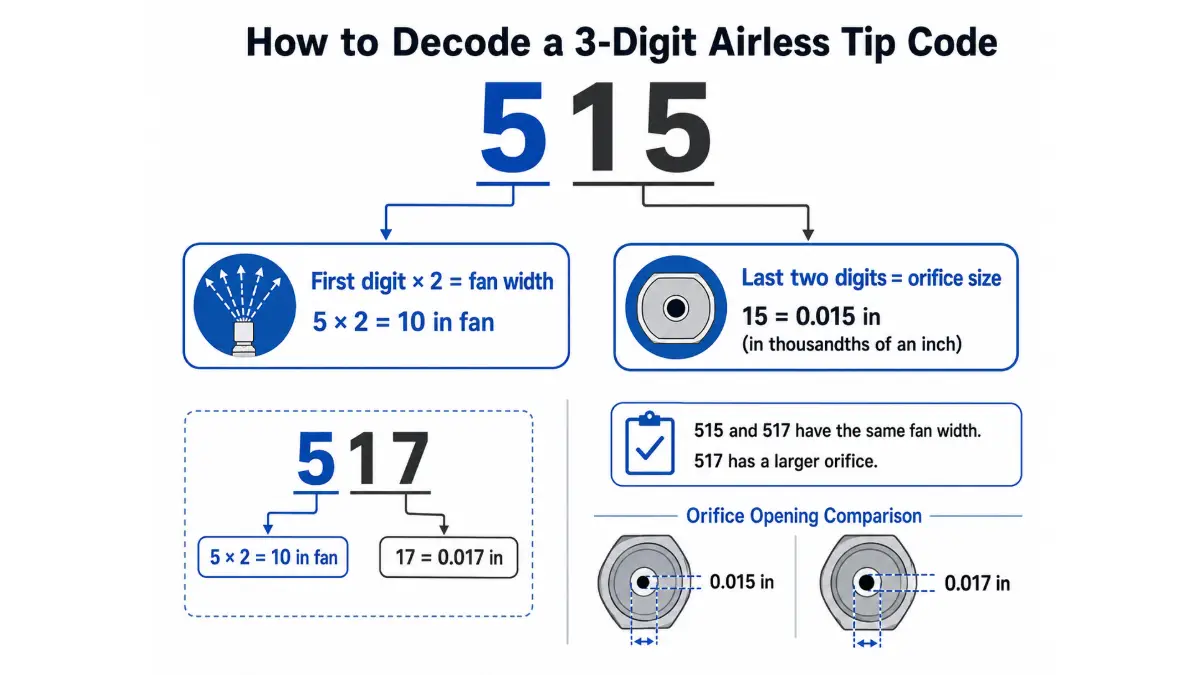
Three digits encode two dimensions. Multiply the first digit by 2 and you get the approximate fan width, in inches, at a 12-inch (30 cm) gun distance: 5 × 2 = 10 inches for both tips. Metric crews multiply the first digit by 5 instead — 25 cm. The last two digits give the orifice in thousandths of an inch: 15 means 0.015 in., 17 means 0.017 in.
Fan width is identical. Coverage per pass does not separate these two tips; fluid delivery does. Two thousandths sounds trivial until you remember flow scales with orifice area, not diameter — the 517’s bore passes visibly more material every second the trigger stays open. For the full orifice-to-coating grid across all sizes, see the airless spray tip size chart.
517 Spray Tip: Flow Output, Viscosity Tolerance, and Sag Risk
A 0.017 in. orifice delivers roughly 0.31 GPM at rated pressure — an industry benchmark measured on water, so expect real-world output below that once viscosity climbs. That flow, plus the wider shear channel, is why the 517 sits as the standard starting orifice for architectural latex: solids pass through instead of bridging, and film builds fast enough to hit spec in fewer passes.
Sag is the tradeoff. At a fixed pass speed, more flow means thicker wet film, and on vertical substrates the film eventually exceeds what surface tension can hold. Operators coming off a 515 keep their old hand speed, over-deposit, and blame the paint. Blame the arithmetic instead — a 517 demands a faster pass, or a deliberate decision to build thicker film.
Where the 515 Wins: Lower Flow, Finer Film Control
Drop two thousandths and the equation flips. A 515 meters less fluid per second (exact output varies by maker — verify against your tip supplier’s flow chart), so the same pass speed lays a thinner, more controllable wet film. That control pays on sag-sensitive vertical faces, on sheen levels that telegraph every heavy spot, and on moderate-viscosity wall coatings where a 517’s throughput is surplus.
One caution: the 515 is not a thin-material tip. Clear varnishes and stains call for a further step down to 0.011–0.013 in. orifices; a 515 over-delivers on those materials. Its lane is conventional wall paint at manageable viscosity, where clog risk stays acceptable and film precision earns money. Push it into unthinned heavy latex and the clog bet returns.
Gun Speed, GPM, and Mil Build: The Decision Matrix
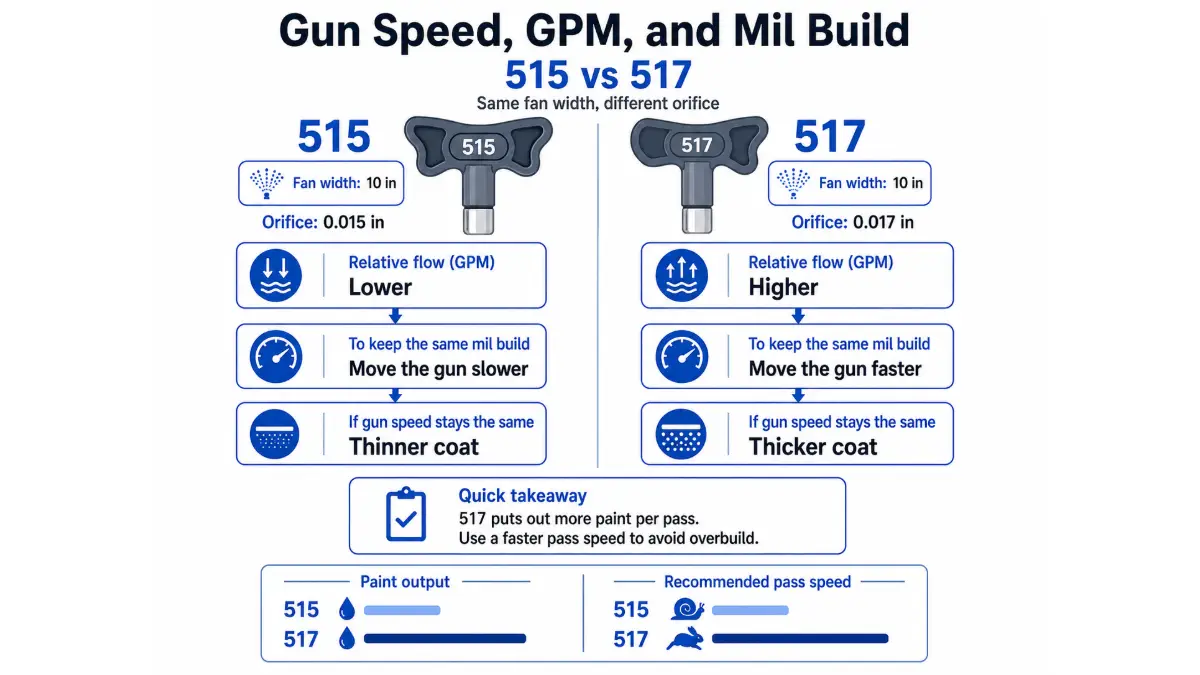
Film build is arithmetic: flow in, divided by pass speed times fan width. Hold two of those constant and the third dictates your wet mil. Hold a steady, brisk pass with 50% overlap, and let tip GPM — not pressure — set your speed. When production demands faster passes, the correct compensation is a larger-orifice tip that restores flow, never a higher pressure setting, which fogs the pattern and accelerates pump wear. Speed sets the film.
| Variable | 515 tip | 517 tip |
|---|---|---|
| Orifice | 0.015 in. | 0.017 in. |
| Fan width at 12 in. | ~10 in. (25 cm) | ~10 in. (25 cm) |
| Flow output | Lower — verify against tip supplier’s flow chart | ~0.31 GPM (industry benchmark, water basis) |
| Viscosity headroom | Tight with heavy-bodied latex | Standard for unthinned architectural latex |
| Gun speed at equal film | Baseline pass | Faster pass, or accept thicker film |
| Primary failure mode | Clogging | Sagging on slow vertical passes |
| Typical assignment | Sag-sensitive faces, moderate-viscosity wall paint | Interior and exterior latex walls and ceilings |
Before locking either tip, pull the coating’s data page and check its wet and dry mil targets against the film your speed-and-flow combination actually lays down — coating manufacturer application guidance such as Sherwin-Williams’ application FAQs covers recommended film builds by product line.
The Worn-Tip Trap: Never Crank Pressure to Save a Dying Orifice
Tips are consumables. Paint is abrasive, and every gallon carries solids that erode the tungsten carbide bore. Wear leaves one signature: the orifice grows while the fan narrows. The industry retirement rule is a 25% fan collapse — a 515 or 517 cuts a fan of roughly 10 inches when new, so once the pattern measures below about 7.5 inches, the tip is done.
Check for wear in the field:
- Trigger a test pass on masking paper at a 12-inch gun distance.
- Measure the fan width and compare it against the rated width for the tip code.
- Retire the tip once the fan drops below roughly 7.5 inches or the pattern edges harden.
The penalty for running past that line is paid three ways: heavier film concentrated into a narrower band, extra overlap passes and wasted paint to even it out, and a pump straining against a bore it was never coded for. Don’t crank the pressure. Replace the tip. Raising PSI to stretch a worn orifice widens nothing, atomizes worse, and transfers the abuse straight into the pump’s packings and valves.
Does Your Sprayer Actually Support a 517? Max Tip Ratings Explained
Flow is the ceiling. A pump must deliver more volume than the orifice releases, or pressure collapses at the gun and atomization falls apart into tails and spatter. Every airless unit therefore carries a maximum supported tip size — a hard boundary, not a suggestion. Our portable line shows the margin question in factory numbers:
| Model | Motor | Power | Max flow | Max tip size |
|---|---|---|---|---|
| GTB-395 | DC brushed | 1000 W | 1.8 L/min | 0.019 in. |
| GTB-490 | DC brushed | 1000 W | 2.0 L/min | 0.019 in. |
| GTB-495 | Brushless | 1500 W | 2.2 L/min | 0.021 in. |
| GTB-595 | Brushless | 2200 W | 2.5 L/min | 0.023 in. |
Read the last column against the tip codes: every model in this table supports a 0.019 in. orifice or larger, so both a 515 and a 517 run with flow margin to spare — the margin that keeps atomization stable as viscosity rises. Pressure ratings follow a three-layer logic worth keeping straight: maximum working output is 3000 PSI (20 MPa) across the line, the system itself is rated to 22 MPa, and the standard high-pressure hose carries its own separate rating of 3300 PSI (22.8 MPa). Tip selection lives inside the first number; the other two are engineering reserve.
Frequently Asked Questions
What is a 515 spray tip used for?
A 515 handles moderate-viscosity architectural wall paints where film control matters: sag-sensitive vertical faces, sheen levels that show heavy spots, and jobs that don’t need a 517’s throughput. Its 0.015 in. orifice lays a thinner wet film at a given pass speed. In unthinned heavy latex, expect more frequent clogs.
What is a 517 spray tip used for?
Interior and exterior latex on walls and ceilings — it is the standard starting orifice for unthinned architectural latex. Its 0.017 in. bore passes solids that would bridge a smaller tip and builds film quickly. Keep the gun moving; slow vertical passes sag.
Can I run a 517 tip on any airless sprayer?
Check the machine’s maximum supported tip size first. A unit rated to 0.019 in. or larger runs a 517 with flow margin; a unit rated below 0.017 in. cannot atomize through it properly. That rating sits in the pump’s specification table, not on the tip.
Does a bigger tip mean higher pressure?
No. Orifice size governs flow, not pressure — a 517 simply releases more material at the same setting. If you need more film per pass, upsize the tip; forcing a small or worn orifice with extra PSI only increases overspray and pump wear.
Tip Ratings Mean Nothing If the Pump Can’t Hold Them: Inside Our Factory Tests

We test every unit. A max-tip rating is a promise about sustained flow under load, and we check that promise twice before a sprayer ships: every control board runs a 4-hour powered burn-in, and every assembled machine runs a 30-minute continuous high-pressure load test on the line.
Behind those tests sit three quality gates — first-article, in-process patrol, and final inspection. Our plant runs 200+ CNC machining stations, dimensional inspection is anchored by a German Carl Zeiss coordinate measuring machine, and core components — pump bodies included — are 100% produced in-house. That chain keeps the flow and tip figures in the table above ours to stand behind.
Sourcing for a contractor fleet or an OEM program? Browse the electric airless paint sprayers line for full specifications, or send us your coating list and daily output target — matching orifice, flow, and machine is the work our engineers do before quoting.