Paint Sprayer for Oil Based Paint: Coating List, Tip Sizes, and Solvent Discipline
A paint sprayer for oil based paint has to cover alkyd enamels and topcoats, oil-based primers and wood sealers, oil-based and penetrating wood stains, lacquers in nitrocellulose, cellulose, pre-catalyzed and catalyzed forms, varnishes and polyurethane topcoats, shellac, basecoat and clearcoat systems, and light-build DTM or thinned epoxy. Orifice size sets the viscosity ceiling: 0.009–0.013″ for thin materials, 0.015–0.019″ for latex, enamels and primers, with 0.021″ the top of this tip class. Halogenated hydrocarbon fluids are excluded outright. Every material on that list is flammable, so the work requires at least 6 m (20 ft) of clearance from explosive vapors, forced ventilation, and grounding across the machine, hose, gun and metal pail.
Retail listings answer one question about solvent-borne work: can the machine spray it. That is the easy half. What ruins jobs, and pumps, is everything around the spray — which orifice the coating needs, what a halogenated solvent does to aluminium parts, whether the pail is still bonded when someone kicks it across the floor. Forum threads skip all of it. Below is the full chain a paint sprayer for oil based paint has to survive.
Solvent-Borne Work Moves Three Variables at Once
Switching from latex to an alkyd enamel is not a bucket swap. Three variables move as a set, and the industry rule is that they have to scale together: coating viscosity, tip orifice, and pump displacement. Heavier material needs a larger orifice, a larger orifice pulls more flow, and more flow eats pump capacity. Force an oversized tip onto an underpowered pump and what comes out is an un-atomised stream, not a fan.
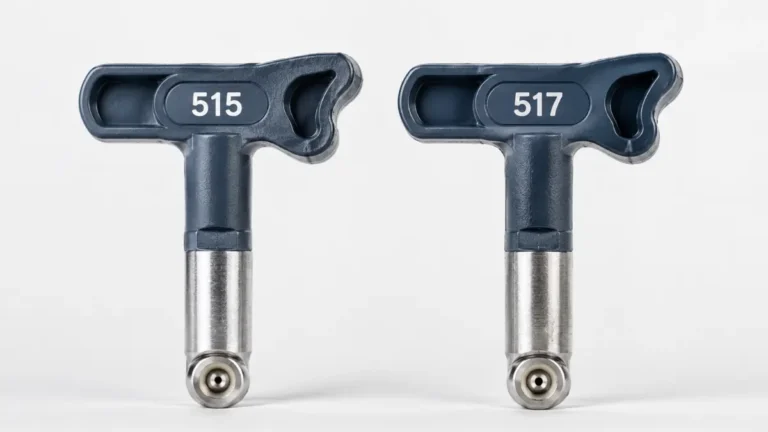
Tip numbering is shorthand for the middle variable. Industry convention reads the first digit times two as the fan width in inches at a 12-inch gun distance, and the last two digits as the orifice in thousandths of an inch. A 515 sprays a roughly 10-inch fan through a .015″ orifice.
One source outranks every generic chart, this one included. Most coating manufacturers print a recommended orifice range — often with pressure and filter mesh alongside it — on the can or the technical data sheet, and equipment guides defer to it. Read the can first.
Common guidance on sizing adds a margin: pick a tip below the pump’s maximum rating so there is wear headroom, because an orifice grows as it wears and its flow climbs with it. Start at the ceiling and nothing is left to give.
Waterborne material has its own version of this problem, handled separately in the guide to thinning latex paint for airless sprayer.
Which Coatings a Paint Sprayer for Oil Based Paint Can Handle
Our portable ≤0.021″ tip class carries a defined solvent-borne list. Nothing about it is preference. Orifice ceiling decides where the machine stops, and where the work belongs instead.
| Solvent-borne coating family | ≤0.021″ tip class | Where it falls if not |
|---|---|---|
| Oil-based and alkyd enamels, topcoats | Yes | — |
| Oil-based primers and wood sealers | Yes | — |
| Oil-based and penetrating wood stains | Yes | — |
| Lacquers (nitrocellulose, cellulose, pre-cat, catalyzed) | Yes | — |
| Varnishes, polyurethane and urethane topcoats | Yes | — |
| Shellac | Yes | — |
| Basecoat and clearcoat systems | Yes | — |
| Light-build DTM and thinned epoxy | Yes | — |
| Elastomeric, textured and knockdown coatings | No | Needs ≥0.025″ orifice |
| Block filler, drywall mud, putty, gypsum plaster | No | Texture and plaster line |
| Bitumen, heavy intumescent fireproofing | No | Heavy-duty line |
| 100%-solids high-build epoxy, zinc-rich primers | No | Industrial and hydraulic line |
Below that ceiling the orifice bands do the sorting. Thin materials — clears, lacquers, penetrating stains — run 0.009–0.013″. Enamels, primers and latex sit at 0.015–0.019″. And 0.021″ is the top of the class, not a place to start.
Each model tops out where its pump does. GTB-395 and GTB-490 reach 0.019″. GTB-495 and GTB-595 reach 0.021″. Machines in this band sit in the portable airless paint sprayers range.
Tip Sizes and Pressure Ranges for Enamels, Lacquers, Varnishes, and Stains
Third-party guides put solvent-borne coatings into three orifice bands. Ranges differ between sources, so they are given as composites rather than averaged into false precision.

| Solvent-borne coating class | Composite orifice range | Fine-finish low-pressure band |
|---|---|---|
| Clears, lacquers, varnishes, penetrating stains | .009–.015″ | .008–.010″ for stains and lacquers |
| Oil-based and alkyd enamels, cabinet and trim | .010–.015″ | .013–.014″ for high-solids cabinet paints |
| Oil-based primers and sealers | .013–.019″ | .011–.012″ for sealing primers |
Pressure is where sources diverge hardest, so read them by name instead of blending them. Coating makers publish working ranges on their own data sheets — Behr lists 1,400–2,400 PSI across its architectural products, Benjamin Moore 1,500–2,500 PSI on the Regal Select and Ultra Spec lines, Sherwin-Williams a flat 2,000 PSI for ProMar 200. Those are architectural figures tied to those products, not a solvent-borne rule — what they show is where the number lives. Your alkyd enamel has its own sheet, and it wins.
Setting pressure follows a rule that holds no matter whose chart you started from. Begin low, test on cardboard, and raise in small increments only until tails, fingers and holidays disappear from the pattern. Stop there.
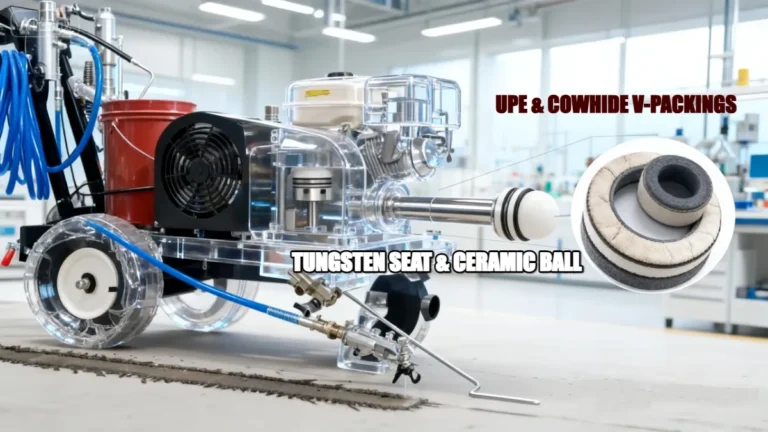
Past that point more pressure buys nothing. Overspray climbs, material bounces back off the surface, the orifice wears faster, and pump packings wear with it.
One hardware option lowers the entire band. Low-pressure fine-finish tips place a pre-orifice ahead of the final tip, so atomisation happens in two stages — a shear pass through the pre-orifice, then a slower pass through the forming orifice. Fans come out softer, with a feathered edge, at markedly lower pressure. Finish work also runs narrow: first digit 2, 3 or 4, giving 4 to 8 inches of fan at 12 inches. Vendor claims about how much pressure this saves belong to the vendors making them.
Grounding an Oil Based Paint Sprayer, the Hose, the Gun, and the Metal Pail
Every coating on the sprayable list burns. That moves the failure mode: the thing that ends a job is not a ragged fan, it is a static spark in a vapor cloud.
Grounding is a chain of four points — the machine, the hose, the gun, the metal pail. Skip any one and the requirement is not met. There is no partial grounding.

Before flammable material goes into the pump:
- Move the work at least 6 m (20 ft) away from explosive vapors.
- Run forced ventilation for the duration of the job.
- Clear ignition sources from the area.
- Ground all four: machine, hose, gun, metal pail.
- Keep a fire extinguisher within reach.
- Read the SDS for the coating and for the solvent.
- Never spray halogenated hydrocarbon fluids.
Hazardous (explosive) locations are out entirely, whatever the coating.
Spray finishing work in the United States is also governed by OSHA’s spray finishing standard.
Before any tip or filter service, follow the pressure release procedure in the machine’s own manual. Do not improvise one.
Halogenated Solvents and Aluminium Components: Never
One line on the material list is a prohibition, not a preference. Halogenated hydrocarbon fluids — methylene chloride and 1,1,1-trichloroethane among them — react violently with aluminium components, and the manuals carry it as a dedicated warning section headed high-pressure aluminium components hazard.
Check the SDS before any liquid goes near the pump, coating and solvent alike. If the sheet lists a halogenated hydrocarbon, that container does not go in. No dilution. No short flush. No exception for cleanup.
Cleaning a Paint Sprayer for Oil Based Paint When the Job Ends
Picking a paint sprayer cleaning solvent starts with the coating’s own data sheet. Water flushes latex; oil-based material takes the matching thinner. For the exact product and ratio, verify against your coating manufacturer’s data sheet on-site.
Filtration comes out in three stages, and they are not interchangeable. Inlet strainer at the pickup protects the pump. Manifold filter sits at the pump end, ahead of the hose. Gun filter is last, and it guards the orifice. Mesh gets finer toward the gun.
Mesh direction trips people up, so state it the long way: a higher mesh number means smaller holes and finer filtration. Match it to the orifice you are protecting rather than to the coating alone — 100 mesh for .011–.015″ orifices, 60 mesh for .017″ and larger.
Tip cleaning is where good equipment gets destroyed. Carbide is hard and brittle, and metal on the orifice scars or chips it permanently.
- Soak the tip in the matching solvent to dissolve dried coating; a dedicated soak jar runs roughly 15 minutes to an hour.
- Brush both faces with a soft or nylon brush.
- Blow compressed air through from the front.
- Hold it to the light and confirm the orifice reads clear.

Never take a wire brush to it. Some consumer guides show a fine needle passed from the back; technical sources do not recommend it, and it stays a disputed practice.
Clogs on a reversible tip clear without disassembly:
- Engage the trigger lock.
- Rotate the tip about 180° to the unclog position.
- Release the lock and aim into a waste pail.
- Trigger briefly so pressure pushes the clog out through the back of the orifice.
- Rotate back to the spray position.
After two failed attempts, swap the tip and soak the old one later.
Worn tips and clean tips look identical until they spray. Compare the fan against a new tip of the same size on cardboard: the pattern drifts from a rectangular stripe toward oval and finally round, and roughly 25% fan collapse is the replacement point. Related reading: how to clean airless sprayer covers the full end-of-job teardown.
Built and Verified in Our Own Plant
Verification happens before a machine ships.
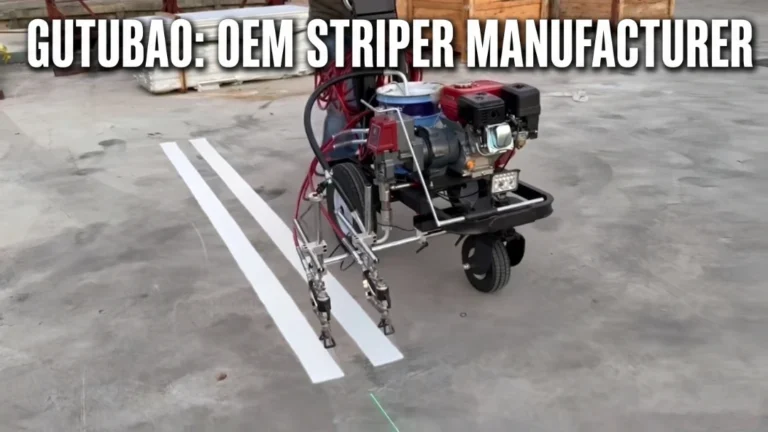
Founded in 2010, GUTUBAO runs a floor of more than 200 CNC machines. Pump bodies, aluminium housings and filters are cut on Japanese Brother SPEEDIO S700Z1 equipment, which indexes automatically in a single setup so both faces machine without a second fixturing. Connecting rods, pistons and plunger bores run on American Haas machines, boring both holes simultaneously in one operation to hold parallelism and stop the piston wearing eccentric.
Critical machined metal mating surfaces are held to ±0.01mm. A German Carl Zeiss coordinate measuring machine runs on the inspection floor.
Inspection covers every unit, not a sample. Three process checks run in sequence — first article, patrol, final. Then the two-stage finished-product test: 4 hours of powered burn-in on the PCB, and 30 minutes of continuous high-pressure load on the assembled machine, both before anything ships. Boards that fail get marked and racked apart from the rest; boards that pass are re-tested installed in a machine before they reach stock.
Core components stay in-house at 100% — the pump body, the motor, the intelligent PCB. Annual capacity stands at 100,000 units. Domestic market share sits near 70%, and the machines export to dozens of countries. OEM and ODM programmes run under NDA.
GUTUBAO machines the pump body, winds the motor, and builds the control board for every machine that leaves the plant. Each of those parts comes off a line we own and run. For daily production work, specify from the electric airless paint sprayers range; when the material sits above this tip class, step up to hydraulic airless paint sprayers. Send your coating, daily output and tip requirement through the RFQ form and our engineers will spec the model against them.
Frequently Asked Questions
Can you put oil based paint straight into a sprayer without thinning it?
Oil-based and alkyd enamels, primers, stains, lacquers, varnishes and shellac all sit on the sprayable list for a ≤0.021″ tip class, with no thinning condition attached. Whether a given product may be thinned, and by how much, belongs to the coating manufacturer. Verify against your coating manufacturer’s data sheet on-site.
What do I flush the pump with after spraying oil based paint?
Match the flush to the coating: water for latex, the matching thinner for oil-based material. A dedicated soak jar for the tip runs roughly 15 minutes to an hour. Filtration itself comes out in three stages: inlet strainer, manifold filter, gun filter. For the exact solvent and any ratio, verify against your coating manufacturer’s data sheet on-site.
Do I need a dedicated spray gun for oil based paint?
The gun itself is not the variable. Two things are: the gun has to sit inside the four-point grounding chain along with the machine, hose and metal pail, and the tip it carries has to fall inside the 0.009–0.021″ band this class covers.
Is a paint sprayer for enamel paint set up differently from one for latex?
Water-based enamels spray with no added conditions. Oil-based and alkyd enamels spray too, but as flammable material, which brings the clearance, ventilation, grounding and SDS requirements with them. Orifice selection follows the same three bands either way. Real difference sits in the safety discipline and the cleaning medium, not in the machine class.