The Ultimate Airless Spray Tip Size Chart: Airless Tip Sizes Explained
The right spray tip selected using a professional airless spray tip size chart is key to achieving a professional finish while saving time, paint, and labor. Combining the correct spray tip with your gun plays a big role in helping you create the professional finish your job demands. Not only does the tip determine how much fluid will leave the gun when you pull the trigger, the spray tip also determines how wide a spray fan the gun will create.
Using the right spray tip is critical. On top of achieving a better spray quality, it saves you from wasting material and makes you work faster. Choosing the right spray tip is essential to ensure a quality finish, no matter which coating material is being sprayed.
Airless Tip Sizes Explained (How to Read the 3-Digit Code)
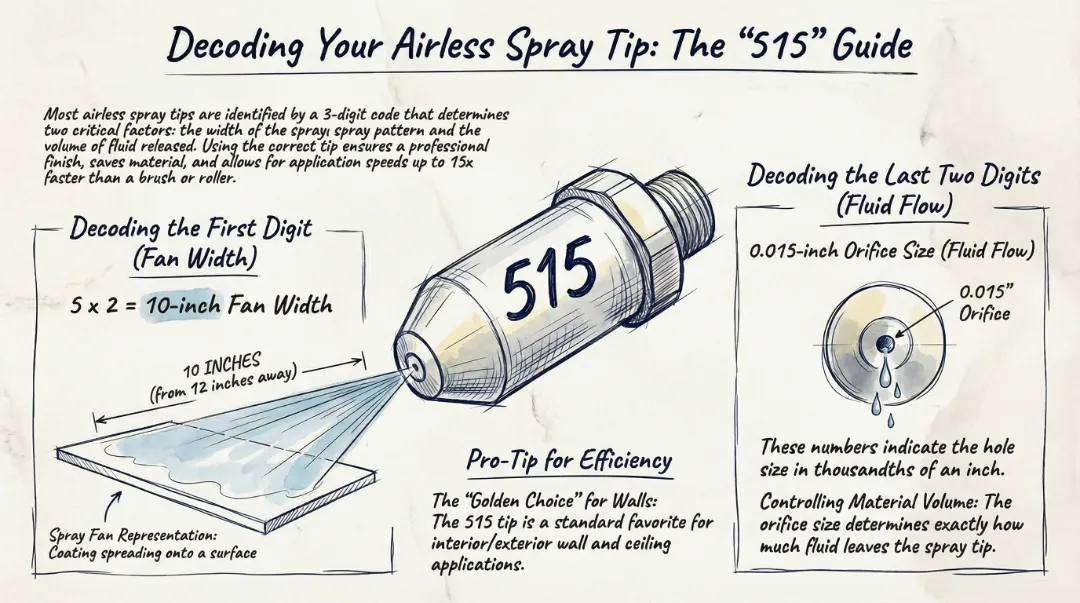
Most spray tips are identified by a 3-digit code. The first digit multiplied by 2 equals the fan width at 12 inches (30 cm) away from the surface. The second two numbers are the orifice size of the tip, in thousandths of an inch, which determines how much fluid will leave the spray tip.
The 3-Digit Rule:
- First Digit x 2 = Fan Width (in inches)
- Last Two Digits = Orifice Size (in thousandths of an inch)
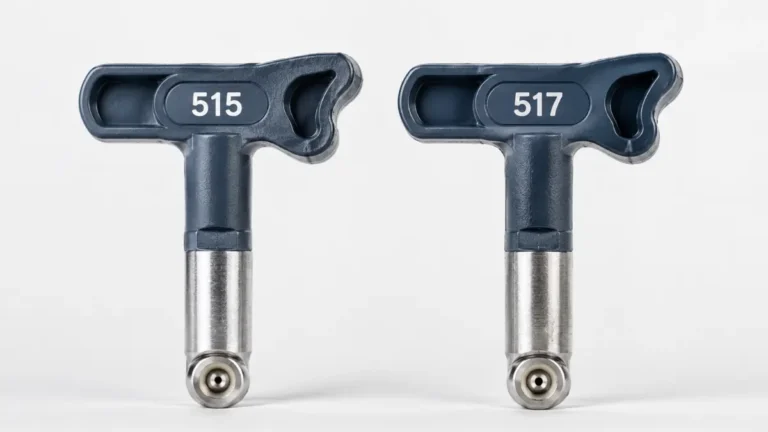
Example: A 515 tip sprays a 10-inch fan, with a 0.015-inch orifice.
💡 Pro Tip: 317 tip vs 517 tip
Both have a 0.017″ orifice (same fluid flow). However, the 517 has a 10-inch fan, while the 317 has a 6-inch fan. Because the same amount of paint is leaving the orifice but is being dispersed across a wider fan, the 517 tip will deliver a thinner coating with less mil build. It’s the combination of fan-width and orifice-size that determines how thick of a coating you’ll spray.
The Ultimate Tip Selection Matrix (Fan Width vs. Orifice Size)
Use this matrix to find the exact 3-digit tip code based on your desired fan width and the thickness of your coating.
| Fan Width (@ 12″ Dist.) |
0.011″ (Thin) | 0.013″ | 0.015″ (Medium) | 0.017″ | 0.019″ | 0.021″ (Thick) | 0.023″+ |
|---|---|---|---|---|---|---|---|
| 4″ – 6″ (2 Series) | 211 | 213 | 215 | – | – | – | – |
| 6″ – 8″ (3 Series) | 311 | 313 | 315 | 317 | – | – | – |
| 8″ – 10″ (4 Series) | 411 | 413 | 415 | 417 | 419 | – | – |
| 10″ – 12″ (5 Series) | 511 | 513 | 515 (Standard) | 517 (Popular) | 519 | 521 | 523 |
| 12″ – 14″ (6 Series) | – | 613 | 615 | 617 | 619 | 621 | 623 |
| 14″ – 16″ (7 Series) | – | – | – | 717 | 719 | 721 | 723 |
Airless Spray Tip Size Chart by Paint Material
Choose a tip with an orifice size rated for the paint or coating you’ll be spraying. Light coatings such as lacquers, stains, and enamels require a small tip, while heavier coatings such as texture require larger spray tips. Many material manufacturers specify recommended spray tip orifice sizes on the container or product specification sheet.
The tip size and fluid pressure are what determine the material flow rate. The higher the number, the faster the material leaves the gun.
| Viscosity Level | Specific Coating Material | Orifice Size (Inches) |
|---|---|---|
| 💧 Thin Materials | Varnishes | 0.009 – 0.011 |
| Lacquers, clear coat | 0.009 – 0.011 | |
| Shellac (clear) | 0.009 – 0.013 | |
| Stains – transparent | 0.011 – 0.013 | |
| Water sealers (thin, clear) | 0.011 – 0.013 | |
| Tung Oil (pure thinned) | 0.011 – 0.013 | |
| 🌊 Medium Viscosity | Oil based paints | 0.013 – 0.015 |
| Lacquers, water borne | 0.013 – 0.015 | |
| Acrylics, clear | 0.013 – 0.015 | |
| Acrylics 100%, latex int | 0.013 – 0.015 | |
| Varnishes (low VOC) | 0.013 – 0.015 | |
| Polyurethanes | 0.013 – 0.015 | |
| Stains – solid | 0.013 – 0.015 | |
| Enamels – oil-base | 0.013 – 0.015 | |
| Primers – latex | 0.015 – 0.017 | |
| Latex paint – interior | 0.015 – 0.017 | |
| Primers – oil | 0.017 – 0.019 | |
| Latex paint – exterior | 0.017 – 0.019 | |
| 🍯 Thicker Materials | Sealers | 0.017 – 0.021 |
| Membrane | 0.017 – 0.021 | |
| Epoxy | 0.017 – 0.021 | |
| Heavy Latex | 0.021 – 0.025 | |
| Elastomerics (smooth) | 0.021 – 0.025 | |
| Epoxy (heavy) | 0.023 – 0.027 | |
| Membrane (heavy) | 0.023 – 0.027 | |
| 🧱 Very Thick Materials | Elastomerics | 0.025 – 0.039 |
| Block Fillers | 0.025 – 0.039 | |
| Membrane (very heavy) | 0.029 – 0.039 | |
| Epoxy (high solids) | 0.029 – 0.039 | |
| Solventless | 0.029 – 0.039 |
Recommended Spray Tips by Application
The width of the spray fan is important for the type of project you’re spraying. The wider the spray distribution, the faster you paint larger surfaces, but the consumption of paint is greater. With a smaller distribution, you work more slowly, but you use less paint and you have more control. Your spray pattern height needs to match the part you are spraying. Depending on the size of the project, using an incorrect spray pattern height can easily double or triple the time on the job.
| 🏠 Interior Painting Applications | |
|---|---|
| Application | Tip Sizes |
| Walls and Ceilings | 515, 615, 517, 617 |
| Doors | 310, 410, 311, 411, 412 |
| Windows | 210, 310, 211, 311, 212, 312 |
| Trim | 310, 311, 312 |
| Cabinets | 310, 410, 311 |
| Furniture | 310, 410 |
| 🏡 Exterior Painting Applications | |
|---|---|
| Application | Tip Sizes |
| Walls and Ceilings | 515, 517 |
| Gutters and Fascia Boards | 413, 415, 515 |
| Wood Siding | 515, 615, 517, 617 |
| Stucco Walls | 515, 615, 517, 617 |
| Exterior Brick | 515, 615, 517, 617 |
| Exterior Doors and Windows | 413, 415 |
| Exterior Trim | 413, 415, 515 |
| Elastomeric Paint | 523, 623, 525, 625, 527, 627 |
Understanding Tip Types: Standard vs. Fine Finish Technology
Instead of relying purely on a color-coding system—which can vary widely between different manufacturers and aftermarket brands—it is more important to understand the internal geometry of the spray tip.
- Standard Airless Tips: These are the workhorses of the industry, ideal for high-production residential and commercial jobs where speed and coverage are the priorities. They are typically used for spraying standard latex, primers, and solid stains.
- Fine Finish Tips: Fine finish tips utilize a specialized dual-orifice or pre-orifice design that atomizes the coating twice. This advanced internal geometry produces a finer atomization and softer, overlapping spray edges. It allows contractors to achieve a glass-smooth finish on sheer-sensitive materials like lacquers, varnishes, and cabinet enamels. Fine finish designs often allow you to spray at slightly lower operating pressures, which drastically reduces overspray, saves expensive material, and minimizes wear on your sprayer’s fluid pump and the tip itself.
- Heavy-Duty / Texture Tips: For abrasive coatings, block fillers, or elastomerics, heavy-duty tips use a harder grade of tungsten carbide and a larger orifice design to prevent clogging and withstand extreme wear. Pairing one of these texture tips to the right rig is its own problem — our stucco sprayer machine guide covers machine-to-orifice sizing for plaster and stucco.
Matching the Spray Tip to Your Airless Sprayer’s Capacity
Size the spray tip according to the tip rating of your sprayer. You must match the tip rating of the sprayer and make sure that the sprayer can support the tip you are planning to use. Always check if your chosen orifice size is compatible with the maximum tip size of your sprayer.
| Orifice Size | Flow Rate (GPM) | Flow Rate (L/min) | Best Suited For | Minimum Sprayer Required |
|---|---|---|---|---|
| 0.011″ | 0.12 GPM | 0.45 L/min | Lacquers, Clear Coats | GTB-395 (2.0 L/min) |
| 0.013″ | 0.18 GPM | 0.68 L/min | Stains, Varnishes | GTB-395 (2.0 L/min) |
| 0.015″ | 0.24 GPM | 0.91 L/min | Oil-Based Enamels | GTB-395 (2.0 L/min) |
| 0.017″ | 0.31 GPM | 1.17 L/min | Interior Latex | GTB-395 (2.0 L/min) |
| 0.019″ | 0.38 GPM | 1.44 L/min | Exterior Latex, Primers | GTB-490 (2.0 L/min) |
| 0.021″ | 0.47 GPM | 1.78 L/min | Heavy Latex | GTB-495 (2.2 L/min) |
| 0.023″ | 0.54 GPM | 2.04 L/min | Elastomerics | – |
- The GUTUBAO GTB-395 (1000W DC Brush Motor, 2.0 L/min, supports max 0.019″ tip) and GUTUBAO GTB-490 (1000W DC Brush Motor, 2.0 L/min, max 0.019″ tip) supply constant flow for interior finishes.
- The GUTUBAO GTB-495 (1500W Brushless DC motor, 2.2 L/min, max 0.021″ tip) and GUTUBAO GTB-595 (2200W Brushless DC motor, 2.5 L/min, max 0.021″ tip) pack the power to push heavier materials.
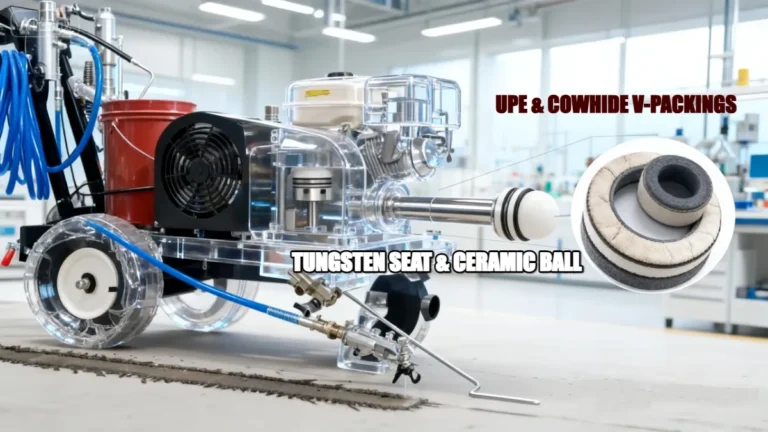
The piston pump does the work of drawing the coating from your source bucket and then pressurizes the coating. As a premier source manufacturer, our fluid pump sections are machined by Japan Brother SPEEDIO CNC centers to a strict 0.01 mm tolerance. This precision is rigorously verified by German Carl Zeiss CMMs. Plungers utilize Hardened Stainless Steel or Ceramic-Coated Rod for extreme abrasion resistance. Fewer moving parts mean less maintenance and longer life. These components have been painstakingly optimized to most effectively pump high and low viscosity materials.
Understanding Tip Wear, Replacement Schedule & FAQ
While spray tips are made out of the highest grade of tungsten carbide – the most abrasive-resistant material available – all spray tips will wear with normal use. Using a worn tip can cost you hundreds of dollars in wasted paint and labor. When a tip wears, the orifice size increases and fan width decreases. This wastes paint, increases labor, and forces more spray passes. A worn tip can also surface as airless sprayer spitting at the gun; if the pattern stutters, the cause is usually tip-or-pressure, not the pump.
Tip life varies by coating. Recommended replacement times:
- Latex paint: Replace after 15-40 gallons (55-150 Liters).
- Oils & Stains: Replace after 35-60 gallons (130-225 Liters).
💡 Pro Tip: Always turn down the pressure as low as it can go, while still spraying a good spray pattern. Spray at the lowest pressure that completely atomizes the coating to prolong tip life.
FAQ: Quick Airless Tip Answers
What size airless tip is best for latex paint?
For standard interior or exterior latex paint, tip sizes from 0.015″ to 0.021″ are ideal. The 515 or 517 tip is widely considered the golden choice for wall and ceiling applications. If the coating still atomizes rough at the right tip, the fix is usually viscosity — see our guide to thinning latex paint for airless sprayer.
What size tip should I use for spraying cabinets?
When spraying cabinets with fine finishes like enamel, you want to use a smaller orifice for precision and minimal overspray. A 310 or 311 Fine Finish tip is highly recommended for achieving a mirror-like finish.
(Note: Properly cleaning your sprayer and storing it in a safe, dry place will ensure your equipment and tips are ready for your next job.)