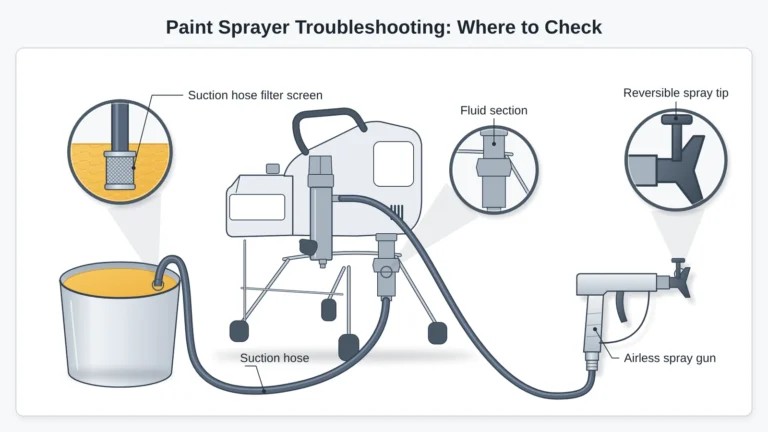
Priming an Airless Sprayer: OEM Pump Troubleshooting
Successfully priming an airless sprayer is the foundational step before any commercial coating project can begin. It relies on the lower pump body’s ability to establish a stable partial vacuum, overcoming fluid gravity and viscosity. When a heavy-duty pump fails to prime or build pressure, the root cause is rarely a simple glitch; it is a mechanical collapse of the fluid section’s suction system. This failure is typically traced to abrasive wear on the V-Packings, compromised valve seats, or micro-leaks in the suction tube. The following guide provides a rigorous, engineering-level breakdown of why priming fails and how to execute professional-grade corrective procedures.
Understanding Why Priming an Airless Sprayer Fails: Root Cause Analysis
When troubleshooting issues with priming an airless sprayer, it is critical to understand that this is fundamentally a positive-displacement system fault — specifically, the inability of the reciprocating pump to sustain sufficient differential pressure across the inlet check valve assembly. Because reciprocating pumps have inherently limited air-handling capability, any degradation of inlet valve sealing integrity will prevent the pump from establishing the partial vacuum required to draw fluid into the lower pump body against gravity and viscosity. (Exact vacuum levels vary with material and altitude and should be verified by field testing.)
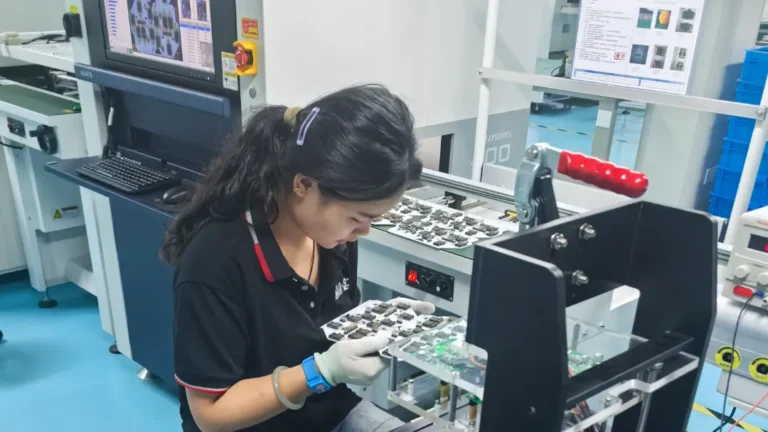
When a pump-mounted smart controller detects sustained low-pressure conditions on the suction side, it triggers a protective lockout. On GUTUBAO smart PCB units, when the fluid pressure drops below 50% of the set pressure and under 2 MPa with the motor running for more than 30 seconds, the system triggers the E_13 Suction Protection fault code. This automatic dry-run lockout prevents catastrophic thermal binding of the packings against the plunger rod. Resolving a sprayer pump not working scenario requires isolating the precise mechanical fault in the fluid section.
Inlet Check Valve Collapse: The Biggest Threat to Suction
On the inlet stroke, the plunger moves upward, creating a low-pressure zone. If the inlet ball check fails to seat fully, atmospheric pressure cannot push fluid up through the suction tube. The primary mechanical causes of inlet valve failure include:
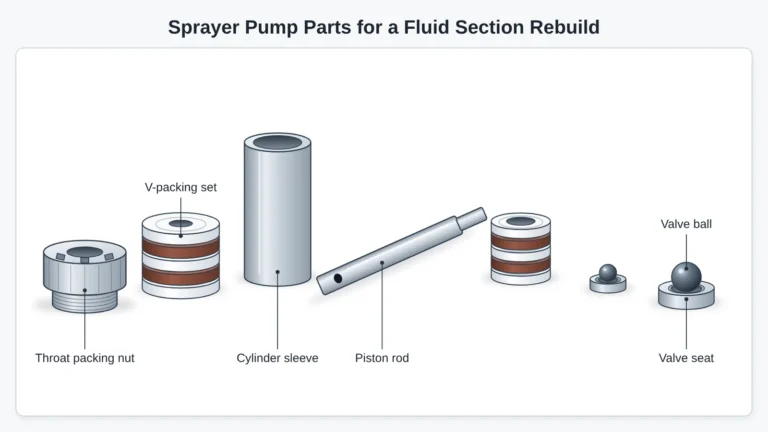
- Packing wear and bypass leakage: As V-Packings wear down, fluid bypasses the piston on the compression stroke. This reduces net displacement per stroke and diminishes the magnitude of the low-pressure zone on the subsequent inlet stroke, destroying the pump’s ability for priming an airless sprayer.
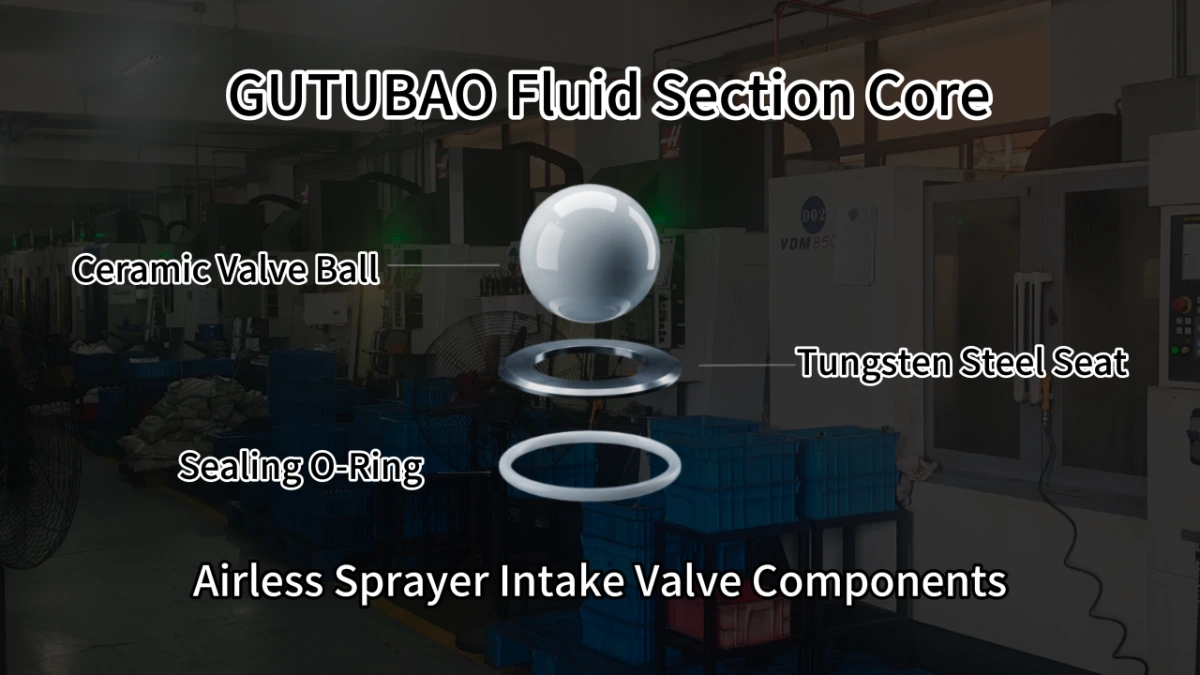
- Inlet ball check fouling or seat wear: Abrasive solids (titanium dioxide, silica aggregates) can lodge between the ball and seat. Over time, high-velocity backflow erodes a groove into the seat face — a failure mode known as wire draw erosion (fluid-cut erosion) — resulting in permanent damage that cleaning cannot correct.
- Air entrainment: A micro-leak at any suction tube joint will introduce air into the fluid column, causing pressure pulsation, cavitation noise, and an immediate loss of prime.
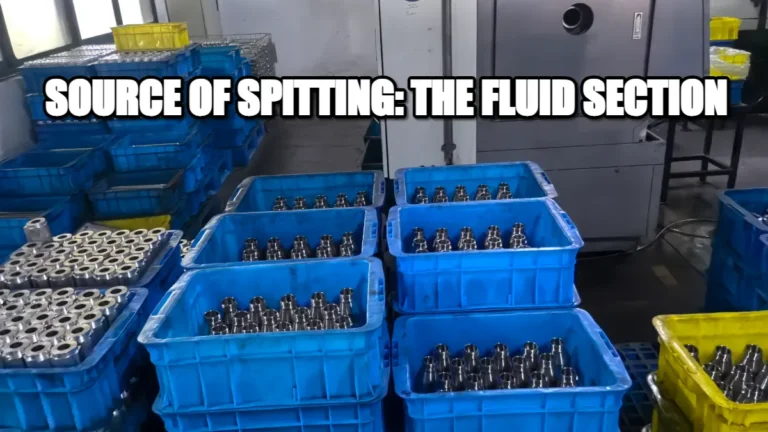
That same air entrainment often shows up as spitting once the pump primes — our why is my airless sprayer spitting guide covers the gun-side checks.
Engineered Materials for Extreme Wear Resistance
Sustaining volumetric efficiency during the process of priming an airless sprayer requires abandoning standard alloys. The service life of fluid section components is directly determined by material hardness and polymer compatibility.
- Valve Seats: The GUTUBAO fluid section uses tungsten steel (cemented-carbide-class) valve seats across the range — a high-hardness material that resists the wire-drawing seen in abrasive coating service.
- Valve Balls: Ball material is matched to the model and application. Ceramic balls are used on models such as the 395 / 495 / 595 / 920 series, titanium-alloy balls on the 935 series, and alloy balls on the 700 / 795 series. Ceramic offers extreme hardness and chemical inertness for abrasive, solvent-aggressive fluids.
- V-Packings: The GUTUBAO fluid section is engineered using Premium White UPE & Cowhide V-Packings. UHMWPE (UPE) offers broad chemical resistance and high sliding abrasion resistance, while cowhide leather provides the conformability and oil retention needed for high-viscosity materials.
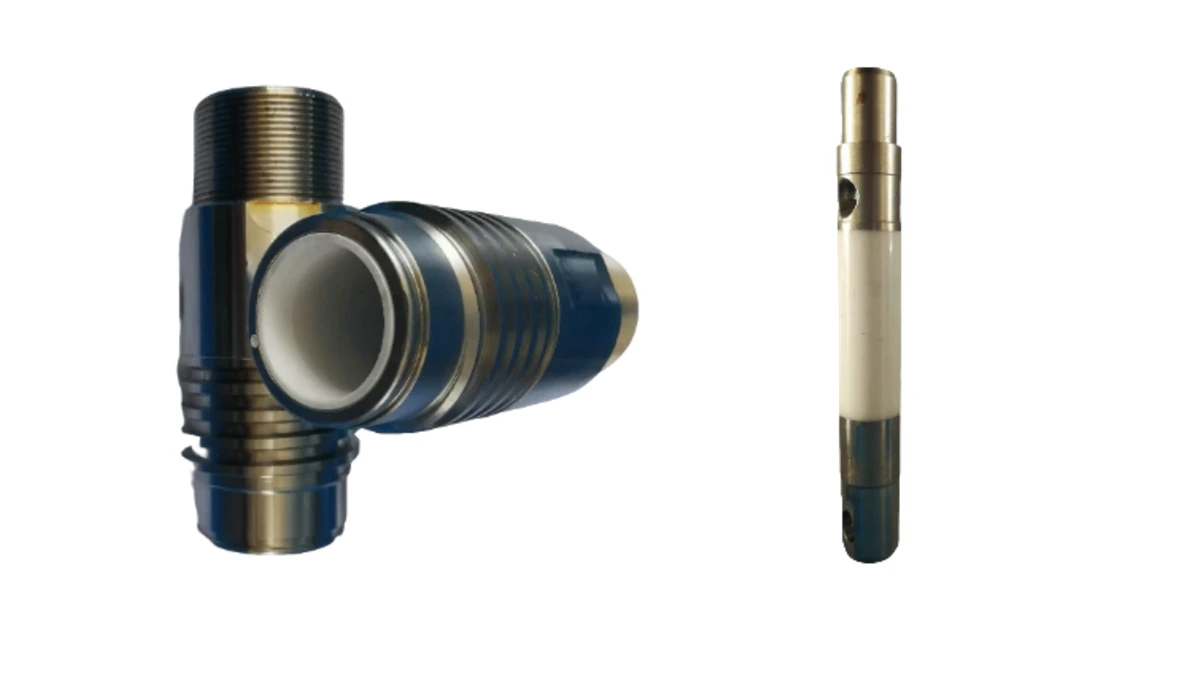
- Plunger Rod & Cylinder Sleeve: Most GUTUBAO models run a ceramic-coated rod paired with a ceramic-lined cylinder sleeve (stainless-steel shell with a ceramic inner bore). Ceramic’s low surface roughness and friction coefficient resist the scoring that destroys the partial-vacuum seal, extending service life well beyond standard stainless components. Entry-level and hydraulic models such as the 395 retain hardened stainless rods and sleeves.
Throat Seal Lubrication: Mandatory Operational Protocol
Correct lubrication of the throat seal (packing stack) is mandatory. Incorrect lubricant selection or placement will cause packing swelling or rapid degradation.
- Application Point: Lubricant MUST be applied at the throat packing nut (Wet Cup) — never into the gearbox oil fill port.
- Protocol: Add 3–5 drops of piston rod lubricant into the wet cup before every startup. Over-lubrication is preferable to dry-running, as excess lubricant is safely displaced into the fluid stream.
- Winter Storage: Purge water and introduce mineral spirits or rod lubricant into the throat before storage. Freezing expansion can crack internal components.Flushing thoroughly before storage is its own discipline — our walkthrough on how to clean an airless sprayer covers the full pressure-relief and flush sequence.
Diagnostic SOP: The 5-Minute Water Prime Test
To physically verify inlet valve integrity without destroying packings via dry friction, execute the following diagnostic sequence:
- Purge the System: Remove the intake foot valve and clean out any texture debris. Ensure all suction-side connections are mechanically tight.
- The Water Prime Test: Fill the pump with clean water and cycle at low pressure in the Prime/Drain position for 5–10 minutes. Water’s low viscosity will confirm whether the pump’s internal geometry is intact. (Do not run water at maximum pressure for 30 minutes, as water lacks the lubricity of paint and can overheat packings.)
- Pressure Hold Test: With the outlet valve closed and the pump stopped, observe the gauge. A pressure drop of >10% per minute indicates internal bypass (worn packings or outlet check).
- Inspect the Seat: Remove the lower retainer. A valve seat showing visible wire draw erosion channels must be replaced — field lapping is not viable for hardened carbide-class material.
| Failure Symptom | Primary Mechanical Cause | Wetted Material Wear Point | Corrective Action |
|---|---|---|---|
| High-Velocity Wire Draw | Ball fails to seat fully due to debris | Tungsten-steel seat / ceramic or alloy ball | Replace complete inlet check valve assembly. |
| Loss of Prime (No Suction) | Air entrainment or dry packings | Suction Tube / V-Packings | Tighten intake joints; add 3–5 drops of rod lubricant to wet cup. |
| Pressure Bypass (Bleed down) | Seal wear reducing differential pressure | Premium UPE & Cowhide Packings | Replace V-Packings or entire fluid section module. |
The OEM Baseline: ±0.01mm CNC Machining & B2B Procurement
When irreversible cylinder scoring destroys the partial-vacuum seal needed for priming an airless sprayer, replacing individual seals becomes mechanically obsolete. To keep commercial coating projects on schedule, always maintain a genuine GUTUBAO complete sprayer pump on hand. Replacing the entire fluid section as a single module eliminates costly downtime.
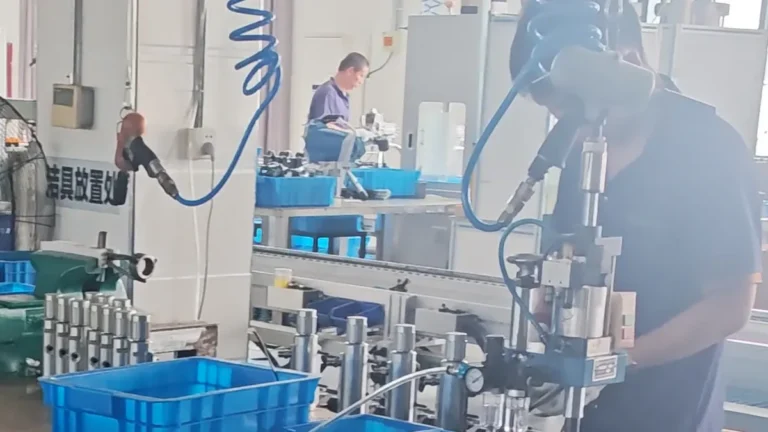
Transitioning from retail component replacement to wholesale strategic procurement requires an OEM partner capable of delivering relentless high-pressure performance. At our 18,000-sqm heavy-industrial facility, GUTUBAO runs elite Japan Brother and USA Haas CNC machining centers. On key machined pump components such as the cylinder bore, these machines hold positional repeatability to a tight ±0.01mm geometric tolerance, locking in the volumetric efficiency the fluid section depends on.
To guarantee positive displacement, production pump cylinders are verified using a German Carl Zeiss CMM (Coordinate Measuring Machine). With a 100,000-unit annual capacity, a full-inspection (not sampling) quality protocol — including 4-hour PCB burn-in and a 30-minute high-pressure load test on every assembled machine — and full support for NDA-backed custom manufacturing, our 100% in-house production matrix delivers B2B reliability for global distributors and contractors.