What Paint Sprayer Do Professionals Use? An OEM Engineering Breakdown
What paint sprayer do professionals use comes down to engineering specifications, not marketing labels. A professional rig is built for continuous-duty production: a brushless motor, a metal fluid section with hardened wear surfaces, an intelligent control board with dry-run protection, and a maximum paint output of 20 MPa (3000 PSI). Consumer machines borrow the word “professional” while running brushed motors, plastic pump bodies, and no thermal cutoff. The real dividing line is whether the equipment survives a full shift without overheating or wearing through its pump. Pressure rating, flow rate (GPM), tip-size capacity, and serviceable metal parts separate a daily contractor tool from a light-duty sprayer. Match those specifications to your coating viscosity and daily output before you read a single star rating.
What Paint Sprayer Do Professionals Use, and Why the Label Misleads Buyers
Search “professional paint sprayer” and the top results often sell you a light-duty machine wearing a contractor sticker. Affiliate sites earn a commission on whatever converts, so an intermittent-use tool gets the same “pro” badge as a rig that runs eight hours a day. The words look identical. The duty cycle does not.
A light-duty sprayer is designed for intermittent use — a fence, a deck, a few rooms. A production sprayer is rated for continuous load: it pumps for hours, handles abrasive high-solids coatings, and takes rebuildable metal parts when something wears. Confuse the two and you buy a tool that overheats by noon.
Cost of getting it wrong shows up as downtime. A stalled job, a burned motor, a pump you cannot rebuild — each one bills against the same crew standing idle. That is the hidden price behind an underbuilt “professional” label.
The Real Engineering Markers of a Commercial Airless Paint Sprayer
Strip away the branding and a commercial machine declares itself through hardware. Five markers matter.
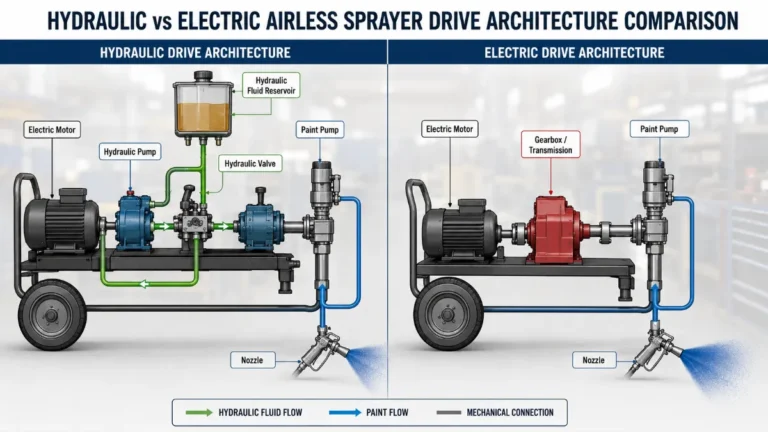
- Motor. A brushless motor runs without carbon brushes to wear down, holding torque under continuous load. Brushed motors cost less and are fine for light use, but the brushes are a consumable.
- Fluid section. The lower pump body should be metal, with a precision-honed bore and hardened wear surfaces — not a plastic housing. Valve seats are tungsten steel; valve balls are ceramic, titanium-alloy, or alloy depending on the model. Spray tips use tungsten carbide, the standard wear material for the orifice.
- Sealing. V-Packings combine UPE (UHMWPE) and cowhide, chosen for rebound under pressure rather than the flat-set failure of plain PTFE.
- Control. An intelligent PCB watches for trouble: motor overheat (E_5) and dry-run suction protection (E_13) cut power before damage spreads.
- Serviceability. Every wear part should be a stocked component you can swap, not a sealed assembly you discard.
These markers track the same logic the coating industry uses for equipment selection. AMPP’s published industrial coating standards frame the durability and corrosion-protection demands of heavy-duty coating work — the operating context these machines are built for.
Pressure, Flow, and Tip Sizing: The Numbers That Separate Pro Rigs
Three numbers tell you whether a sprayer can do production work: pressure, flow, and tip capacity.
Pressure gets misquoted constantly, so separate the three ratings. Maximum paint output on these machines is 20 MPa (3000 PSI). The system itself is rated to 22 MPa, which is why every fitting downstream must hold at least that. The high-pressure hose carries its own rating — 22.8 MPa (3300 PSI) stamped on the jacket. That 3300 figure is a hose spec, not the pressure the pump pushes paint at. Mixing them up is how spec sheets lie.
Flow decides how fast you cover. Tip orifice sets the volume, and that volume is rated on water at 1 cP; high-solids coatings drop the real throughput. Here is the baseline relationship.
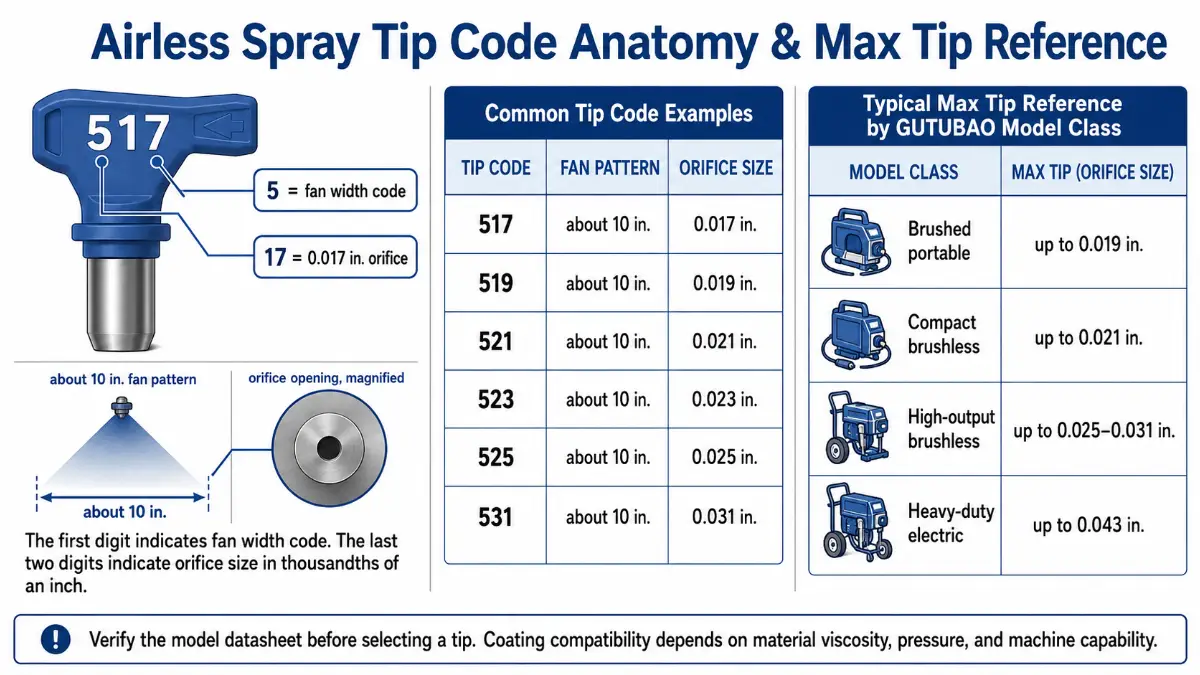
| Tip orifice | Industry-rated flow (water) | Typical use |
|---|---|---|
| 0.017″ | 0.31 GPM | Latex, primers, standard build |
| 0.019″ | 0.40 GPM | Heavier latex, exteriors |
| 0.021″ | 0.47 GPM | High-build, heavy coatings |
Verify tip flow against your tip manufacturer’s chart before sizing a job. Now match that to the pump. A unit’s rated output has to feed the tip you hang on it:
| Model | Motor | Power | Flow | Max tip |
|---|---|---|---|---|
| GTB-495 | Brushless | 1500 W | 2.2 L/min | 0.021″ |
| GTB-595 | Brushless | 2200 W | 2.5 L/min | 0.023″ |
Undersize the pump for the tip and the fan pattern starves at the edges.
Total Cost of Ownership: Why the Lowest-Priced Sprayer Costs the Most
Purchase price is the smallest number in the equation. Total cost of ownership runs on consumables, downtime, and the wear curve of the pump.
Take tip wear as the clearest example. Every coating carries abrasive solids, and the orifice widens as it sprays. A tip that started with a 12-inch fan pattern wears to 9 inches; now you overlap more, lay down more paint per square foot, and burn material. Run the math on common assumptions — paint at $15 a gallon, labor at $25 an hour, spraying 5 gallons an hour — and a worn tip can bleed roughly $36 an hour in wasted material and extra passes. Over a shift, that compounds fast.
One reflex makes it worse:
- Pattern narrows, coverage drops.
- The operator cranks pump pressure to compensate.
- Higher pressure accelerates wear on the tip and the pump packings.
- The pump fails sooner, and the bill lands on the fluid section.
Don’t crank the pressure. Replace the tip.
A pump you can rebuild from stocked parts costs less over its service life than a sealed unit you replace whole. That gap is the real ownership story.
How to Spot a Rebadged Machine Sold as the Best Professional Paint Sprayer
Some red flags show up before you ever pull the trigger. Walk the spec sheet with a skeptical eye.
- Brushed motor on a machine sold for daily use. Brushes are a wear item; for a production schedule, a brushless motor earns its premium.
- Plastic fluid section. If the pump body is molded plastic, abrasive coatings will chew through it; metal with a honed bore is the production standard.
- No thermal protection. A real control board cuts power on motor overheat (E_5). No E-code display usually means no protection at all.
- No parts diagram. If the seller cannot hand you an exploded view and a parts list, you cannot rebuild it — which makes it disposable.
- A “pro” badge paired with a light-duty rating. Read the intended use, not the marketing.
The right machine for your shop is the one whose wear parts you can still buy years down the line.
Why the Supply Chain Behind the Sprayer Decides Long-Term Uptime
Buy a sprayer and you also buy its supply chain. Parts availability is uptime.
A reseller brands someone else’s pump and stocks whatever the importer sends. When a fluid section wears years into service, you wait on a part that may already be discontinued. An OEM that machines its own pump bodies, motors, and control boards keeps the tooling and the inventory — the same line that built the machine can supply the rebuild kit.
That is why sourcing from the factory changes the math. Our OEM coating equipment production line keeps core components in production, so a part that ships today still exists when you need it down the line. Build quality alone won’t save a job if the rebuild kit is unobtainable.
Inside the OEM Line That Builds Professional Airless Equipment
Specifications mean little without the shop that holds them. Here is what stands behind the equipment.
We have built sprayers since 2010, with more than 200 CNC machines on the floor producing pump bodies and core parts in-house. Critical machined metal mating surfaces — cylinder bores, valve seats — are held to ±0.01mm, verified on a German Carl Zeiss coordinate measuring machine. Brother and Haas CNC equipment runs the precision metalwork.
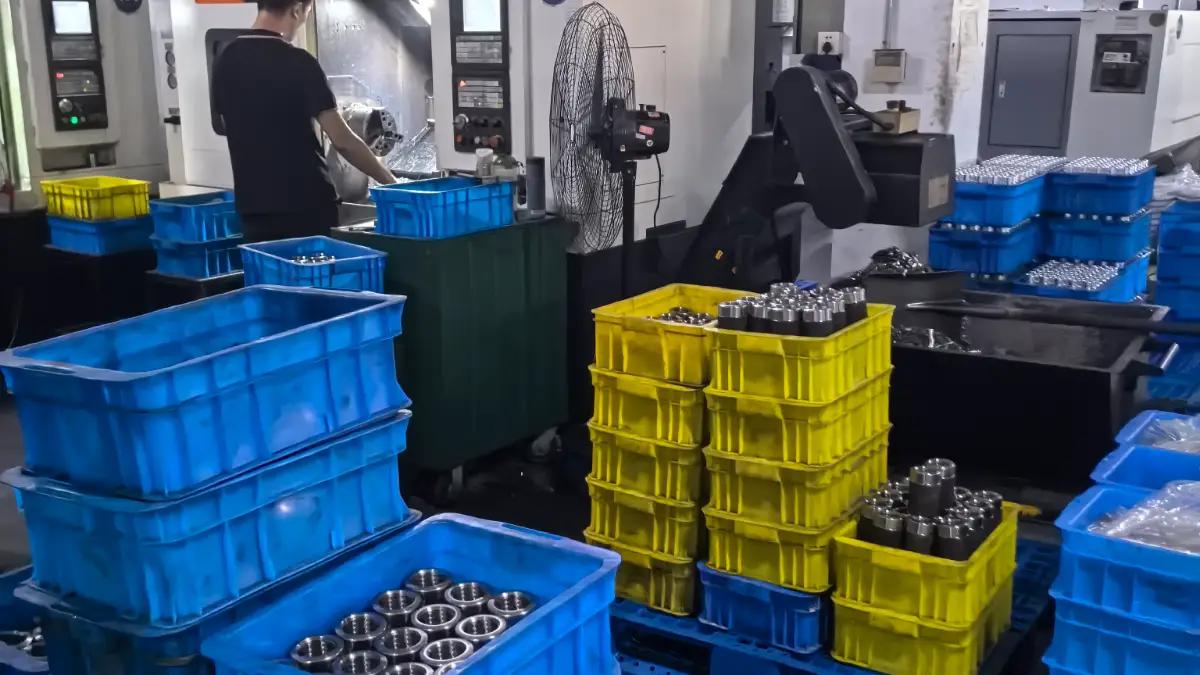
Quality control is full inspection, not sampling. Every unit passes a three-stage process check, then a two-stage finished test: the PCB runs a 4-hour powered burn-in, and the complete machine runs a 30-minute high-pressure load test before it ships. Core components — pump body, motor, intelligent PCB — are produced 100% in-house.
Capacity reaches 100,000 units a year, with roughly 70% domestic market share and exports to dozens of countries. Our production airless sprayers are CE certified under the Machinery Directive 2006/42/EC, EN ISO 12100:2010, and EN 60204-1:2018.
If you are specifying industrial coating equipment for a contractor fleet or an OEM program, the question is not which badge says “professional.” It is which factory still answers when you need a pump rebuilt.
Frequently Asked Questions
What separates a professional paint sprayer from a light-duty one?
A homeowner sprayer is built for intermittent jobs and leans on consumable parts like brushed motors and lighter pump components. A professional machine is rated for continuous-duty load: brushless motor, metal fluid section, rebuildable wear parts, and a control board with overheat and dry-run protection. The dividing line is duty cycle and serviceability, not the label.
Is a commercial airless paint sprayer worth it for a small contractor?
If you spray most weeks, yes. A commercial airless paint sprayer costs more up front but rebuilds from stocked parts, holds output across a full shift, and avoids the downtime a consumer machine racks up under daily load. For occasional use, a lighter machine may be enough — match the tool to your weekly gallons.
What pressure should a professional airless sprayer reach?
Maximum paint output on these machines is 20 MPa (3000 PSI). The system is rated to 22 MPa, and the high-pressure hose carries a 22.8 MPa (3300 PSI) rating. Most architectural and industrial coatings atomize well below the maximum; you raise pressure only enough to break the pattern clean, then stop.
How many hours a day can a professional sprayer run?
No industrial-grade sprayer runs on a fixed timer. Continuous run time is bounded by thermal headroom, not a clock: the controller’s E_5 motor-overheat cutoff and E_13 dry-run protection — which locks the pump after about 30 seconds of starved running — are the real limits. Keep material fed and hold flow within roughly 30–60% of maximum rated capacity, and forced-air cooling plus a metal fluid section carry full-shift duty. Verify the exact duty rating against the manufacturer’s data for your model.