What Size Paint Sprayer Do I Need? A Flow, Tip, and Viscosity Decision Guide
“What size paint sprayer do I need?” is a pump-class question, not a nozzle question — “size” here means the machine tier, not the spray tip orifice. Three numbers decide the tier: pump flow in liters per minute, the maximum tip the pump is rated to feed, and the orifice your coating needs to atomize. Match those three and the pump keeps up with the work. Miss them and you either stall on a heavy coating or pay for output you never use. Airless machines run from compact units feeding tips below .025″ at a couple liters per minute, up through mid-flow electric pumps rated to .041″, and on to hydraulic heavy units that feed tips up to .065″. Read the coating and the daily volume first. Then pick the tier.
Sized Wrong, Paid Twice: The Undersizing and Oversizing Trap
Buy under your workload and the pump chokes on the job. You crawl the gun to lay a full coat, miss the schedule, and burn the crew’s hours standing at a machine that can’t keep up. Buy over it and capital sits idle in output you never touch. Neither error shows on the price tag.
Most buying guides sort machines by price band. Manufacturer pages sort them by product line. Almost none work the problem from the engineering side — how a pump gets pushed to its ceiling by the material and the daily volume. That backward view is the useful one. It is the ruler this guide hands you.
The Physics of Sprayer Size: Flow, Orifice, and Viscosity Lock Together
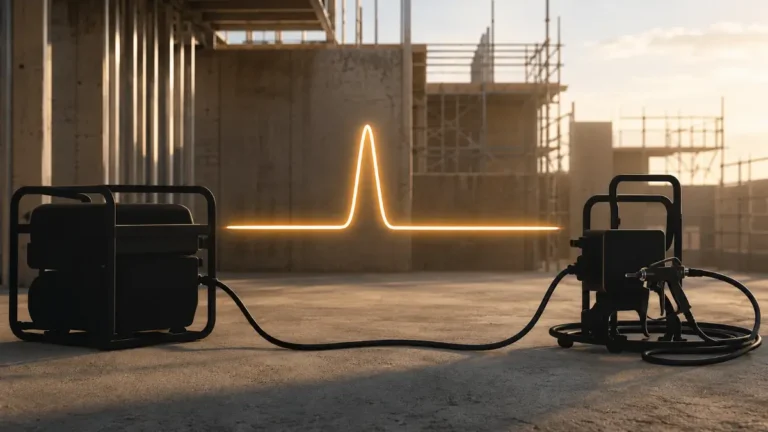
Three variables move together in airless spraying, and you cannot change one without dragging the others. Thicker coating needs a larger orifice to atomize. A larger orifice passes more fluid per minute. More fluid per minute demands more pump displacement. Push viscosity up and the whole chain climbs with it.
Every pump carries a maximum tip rating set by its flow. Pumps rated to a .021″ ceiling cannot feed a .031″ tip — force one on and the pump cycles dry, never builds atomizing pressure, and spits an un-atomized stream instead of a fan. Very heavy coatings make this brutal: fillers and high-solids materials often need well over 4 liters per minute, which only a high-displacement hydraulic unit delivers.
Flow scales with orifice in a fixed way. Measured on water, an industry tip-flow chart (water @ 2,000 psi basis) reads roughly like this:

| Tip orifice | Rated flow (water) |
|---|---|
| .015″ | ~0.24 GPM |
| .021″ | ~0.47 GPM |
| .031″ | ~1.03 GPM |
| .041″ | ~1.8 GPM |
Heavier coatings drop the real number below the water baseline. Bigger tips drink faster. Pumps have ceilings.
One more rule keeps a pump alive. Pick a tip below the pump’s maximum rating so a worn orifice still has headroom — common guidance runs one size down from the ceiling. A tip wears as it sprays: the orifice widens, the fan narrows, and flow climbs past where it started. Start at the ceiling and ordinary wear takes you past it. The full orifice-to-tip-code relationship sits in our airless spray tip size chart.
What Size Paint Sprayer Do I Need for Each Workload Tier?
Set the tier on measured flow and maximum tip, not horsepower or price. The table below sorts our own lines by the two numbers that decide whether a pump clears your work.
| Tier 1 · Compact electric | Tier 2 · High-output electric | Tier 3 · Hydraulic heavy | |
|---|---|---|---|
| Work profile | Intermittent interior and repaint | Continuous commercial schedule | Heavy-build and structural jobs |
| Max tip | below .025″ | .025″–.041″ | up to .065″ |
| Flow | ~1.8–2.5 L/min | ~2.8–10 L/min | ~7.5–22 L/min |
Tier 1 covers the compact end — the GTB-395/490/495/595 line and the GTB-915 through 925, feeding tips below .025″ at roughly 1.8 to 2.5 L/min. This is intermittent work: interior rooms, trim, repaint jobs where the gun runs in bursts. The trade-off between the smallest units is a total-cost question laid out in GTB-395 vs 495. For that class of work, start in the portable airless paint sprayers range.
Tier 2 is the production band: GTB-930 through 980 in the nine series, the mid-flow models above them, and the GTB-8900 topping out near 10 L/min. Tips run .025″ to .041″, flow from roughly 2.8 to 10 L/min. These are the pumps sized for continuous commercial schedules rather than intermittent work. That is the electric airless paint sprayers range.
Tier 3 is a different machine. The reason to step into it comes next.
When to Move Up a Tier: Three Trip Wires
Forget budget as the trigger. Three objective signals tell you the tier below is out of room, and hitting any one of them means moving up.
The first is daily volume against pump flow. A machine sized for intermittent room work is not the machine that sprays a warehouse exterior all week. When the job calls for a paint sprayer for large areas, run day after day, the pump’s rated flow — not its pressure — is the number that runs out first, and the fix is a higher-flow tier. Third-party estimating frameworks put structure under this: the PCA industry standards on estimating show how contractors convert surface area into measured workload, which is the input that sizes the pump.
Coating body is the second trip wire. Match the tier to the material and the budget stops mattering. Orifice demand climbs steeply with body: elastomerics run about .019″ to .039″ and up, heavy filler coats land at .035″ to .039″, and the very heaviest fillers and mastics reach .045″ and beyond.
A compact unit capped below .025″ simply runs out of tier here. Its range stops below the materials that need a bigger orifice — elastomeric, textured, and knockdown coatings that call for .025″ or larger, block filler and drywall mud, bitumen and heavy intumescent fireproofing, 100%-solids epoxy and zinc-rich primers all sit outside it. A contractor speccing a paint sprayer for elastomeric paint is already past the compact band and into the high-output electric or hydraulic range, depending on the orifice the coating actually calls for. The material picks the tier. Not the budget.
Wear headroom is the third wire. When your day-to-day tip already sits at the pump’s rated ceiling, the pump has no margin left — the first wear pushes flow past its capacity.
A compact line whose ceiling stays under .025″ leaves nothing above it for a growing coating spec. Once the job needs more orifice than the ceiling allows, no adjustment recovers it.
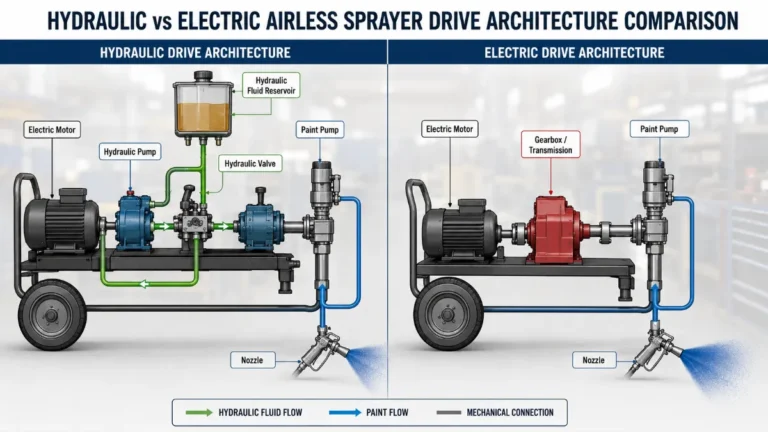
All three wires point the same way. Heavier coatings, sustained high volume, and exhausted tip headroom converge on one architecture — the hydraulic heavy line, feeding tips up to .065″ at 7.5 to 22 L/min, built for structural, anti-corrosion, and high-build work. Note the boundary: the 833 low-pressure thick-slurry machine is a dedicated plaster and texture unit, not a rung on this airless sprayer ladder, and it does not belong in the flow comparison above. The full case for crossing from electric to hydraulic — pressure ceiling, power access, drive architecture — runs in hydraulic vs electric airless sprayer. When the trip wires say go, the hydraulic airless paint sprayers range is where the work lands.
Two Sizing Mistakes That Cost More Than the Sprayer
Two errors show up on jobsites more than any machine fault. Both come from sizing, not hardware.
The first is buying at the ceiling. A pump whose everyday tip equals its maximum rating has no wear margin, and a widening orifice pushes flow past what the pump can feed. Run your everyday tip one size below the pump’s rating, not at it.
Masking an undersized rig with pressure is the second error. Cranking the pump to force a coating it was never sized for only buys overspray, wasted material, and faster wear on the tip and packings. The right pressure is the lowest setting that still breaks a clean fan — you raise to that point and stop. Don’t crank the pressure. Change the tier.
Sizing FAQ: What Contractors Actually Ask
Which paint sprayer for large jobs that run every week?
A job that runs continuously every week belongs in the production band or above — a high-output electric pump from the production band, or the hydraulic line when the coating or volume demands it. Weekly production work is exactly what the workload tiers above are built to sort.
Do I need a different paint sprayer for primer than for topcoat?
Usually no. A paint sprayer for primer works within the same tier as your topcoat as long as the primer’s orifice demand sits inside the pump’s tip range; standard primers spray on compact and electric machines alongside latex, acrylics, and enamels. Check the primer’s recommended orifice against your tip chart before you load.
What is the right paint sprayer for thick paint like block filler or textured coatings?
A paint sprayer for thick paint runs into the material ceiling of the lighter tiers. Block filler, drywall mud, textured and knockdown coatings, and high-solids fillers need a larger orifice than a compact unit can feed and belong on a high-output or hydraulic machine. Size the pump to the orifice the coating actually needs.
When should I jump from an electric unit to a hydraulic one?
When any of the three trip wires fires: the coating needs an orifice past the electric tier’s ceiling, the daily volume outruns electric flow, or your working tip already sits at the pump’s rating with no headroom left. Any one of them is the signal to move up.
Sized and Built in the Same Factory
A sprayer is only as sound as the shop that holds its tolerances. We have built airless equipment since 2010, with more than 200 CNC machines on the floor and core components — pump bodies, motors, and the intelligent control PCB — produced 100% in-house. Critical machined metal mating surfaces, cylinder bores and valve seats, hold ±0.01 mm and are verified on a German Carl Zeiss coordinate measuring machine.
Quality control is full inspection, not sampling. Every PCB runs a 4-hour powered burn-in, and every finished machine runs a 30-minute high-pressure load test before it leaves the line. Separately, three in-process checkpoints — first-article, patrol, and final — run through production itself. Capacity reaches 100,000 units a year. Built to spec, sized to the job.

NDA-backed OEM and ODM run across all three lines. Have the coating, the daily volume, and the site ready when you request a quote — those three inputs are what size the pump.