Can You Use an Extension Cord with an Airless Paint Sprayer?
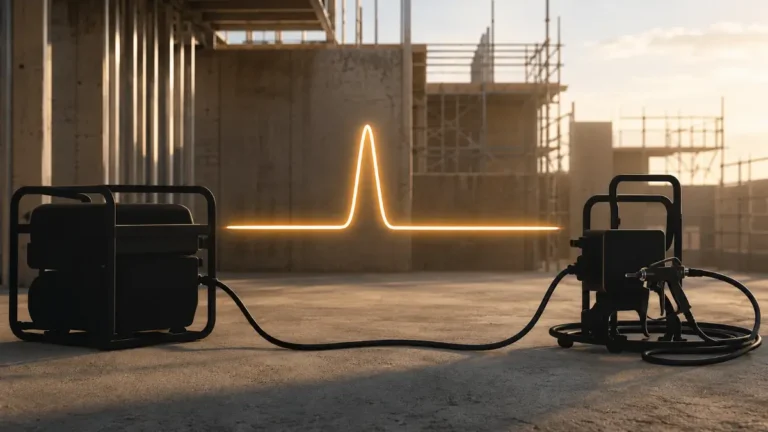
Can you use an extension cord with an airless paint sprayer? Yes—as long as the voltage arriving at the machine’s inlet stays above the documented protection threshold. The electric piston-pump units covered in this article are motor-driven loads, and an undersized or overlong cord drops voltage between the outlet and the machine. GUTUBAO models fitted with the intelligent PCB control board monitor input voltage directly: if the supply at the inlet falls below 170 Vac, the unit stops and displays 170U, the input undervoltage protection code; input voltage running too high triggers 380U. The working rules: run the shortest, heaviest cord available, uncoil it completely, use one grounded cord plugged straight into mains power, and never connect cords in series. A 170U readout on a long cord run puts the supply path first in line for inspection.
Crews hit this question at the exact moment a wall outlet sits too far from the work. The answer to “can you use an extension cord with an airless paint sprayer” is less about permission and more about arithmetic—current, conductor size, and distance. Here is how the electrical side behaves on a real site, and how documented protection codes turn a vague power problem into a readable one.
Why a Paint Sprayer Keeps Shutting Off on Long Cords
A familiar job-site sequence: the sprayer primes fine near the panel, runs for a few minutes at the far end of the building, then stops. No smoke, no tripped breaker, no obvious fault. The crew blames the pump, swaps the gun filter, cycles the prime valve—and the machine stops again.
Check the supply before the pump. A production sprayer can draw up to its nameplate rating under load—25 A on the largest 220 V units—and voltage lost along an undersized conductor never reaches the motor. Near the panel the machine runs on healthy voltage; at the end of a long, thin cord, the input can sag toward the protection threshold, and a control board that monitors input voltage stops rather than runs through it.
Can You Use an Extension Cord with an Airless Paint Sprayer? The Engineering Answer
Yes—and the qualifier is measurable. Airless sprayer voltage drop is a resistance problem: cable adds resistance, load current flowing through that resistance subtracts voltage, and the subtraction lands on the machine’s inlet. Longer cord, thinner conductor, higher amp draw—each one deepens the loss. A cord that feels fine on hand tools can starve a production sprayer.
Undervoltage is the condition the control board is built to refuse. Rather than let the motor keep running on a supply below its design range, the intelligent PCB trips its low voltage protection when input voltage falls below 170 Vac and stops the unit, displaying 170U. The matching 380U code stops the machine when input voltage runs too high. Both are documented shutdown thresholds, not estimates. The threshold is fixed: 170 Vac.
A 170U readout carries exactly one documented meaning: input voltage at the machine fell below 170 Vac. On a long cord run, read that code before anything else—it points the first check at the supply path, not the pump.
Know Your Amp Draw Before You Pick a Cord
Cord selection starts with one number: the machine’s rated current. Spray rigs span a wide range, and supply habits built around a small unit fail on a large one. That spread is the whole story.
| Model (220 V) | Rated power | Rated current |
|---|---|---|
| GTB-915 / 918 | 1000 W | 5 A |
| GTB-920 | 1500 W | 7 A |
| GTB-925 / 930 | 2000 W / 2200 W | 9 A |
| GTB-935 | 2500 W | 14 A |
| GTB-950 | 3500 W | 20 A |
| GTB-980 | 4000 W | 25 A |
| GTB-8900 | 4000 W | 25 A |
A cord that keeps a 5 A unit healthy can starve a 25 A unit into shutdown on the same run. Check the nameplate current of your specific model before mobilizing, and size the whole supply path—breaker, outlet, cord—around it.
Portable units—GTB-395 and 490 at 1000 W, the 495 at 1500 W, the 595 at 2200 W—are specified by power on the data sheet, without a published current column. Don’t back-calculate amps from watts; motor loads don’t behave that neatly. Read the nameplate on the machine, or ask us for the figure for your model.
Choosing an Extension Cord for Paint Sprayer Duty: Field Rules
You will not find a “this length takes that conductor size” chart here—the correct pairing depends on your machine’s amp draw, the cord’s construction, and the circuit feeding it. The field rules, in order:
- Keep the cord as short as the site allows. Voltage loss scales with length.
- Choose the heaviest conductor cross-section available for that length. Long and thin loses volts.
- Uncoil the cord completely. A coiled cord under load traps heat.
- Run one cord, never several in series. Every plug junction adds resistance.
- Plug into fixed mains power wherever possible, on a circuit not shared with other heavy loads.
- Use a grounded, three-conductor cord in good condition—no taped repairs, no missing ground pin.
Then verify the pairing against the cord manufacturer’s ampacity chart for your model’s rated current and the actual run length. For general temporary-power practice, ESFI’s extension cord safety guidelines are a neutral reference; the amp table above is what makes them specific to a spray rig.
When spraying flammable, solvent-based materials, grounding extends past the cord: machine, hose, gun, and metal bucket stay grounded as one continuous path.
Reading the Fault Codes: Supply Problem or Machine Problem?
GUTUBAO’s fault-code table reads the same in the user manuals for the 9-series, the 6xx/8xx mainline, and the 8900, with each code defined by its trigger condition. Read the definitions before assigning blame:
| Code | Documented trigger |
|---|---|
| 170U | Input voltage below 170 Vac (input undervoltage protection) |
| 380U | Input voltage too high (input overvoltage protection) |
| E_8 | Phase loss — motor power lead detached or loosely connected |
| E_4 | Overload — hardware overcurrent signal detected |
| E_14 | Motor stall — motor commanded to run but not turning |
| E_5 | Motor temperature above its limit |
Only 170U and 380U measure the incoming supply directly. E_8 points at the machine’s own motor wiring by definition, and E_4, E_14, and E_5 carry machine-side definitions—none of them, on its own, proves a cord problem. Treat each code as a definition, not a verdict.
A quick test separates the two sides before any teardown:
- Read the code on the display panel.
- Retest at a known-good outlet close to the panel, with no extension cord.
- If the code does not recur there, move the supply path—cord length, conductor size, circuit loading—to the top of the checklist.
- If it recurs, work through our guide to paint sprayer fault codes before touching the fluid section.
Rule the cord in or out first.
Long Cord or Generator? Draw the Line Correctly
Extension cords solve distance from mains power. Generators solve the absence of mains power. Different problem, different math. Running airless sprayer on generator power is a sizing question of its own, covered in our guide to generator size for an airless sprayer. Everything above assumes mains power at the start of the run.
Why GUTUBAO Machines Police Their Own Power Supply
Bad power is a design input. Job sites run long cords, shared circuits, and improvised distribution, so input-voltage protection—the logic behind 170U and 380U—ships as part of the intelligent PCB fault-code system documented in the same three manual families cited above. The intelligent PCB platform also carries voice fault prompts and a modular board layout.
Our line tests are specific and repeatable. Every control board passes a 4-hour powered burn-in, and every finished machine runs a 30-minute continuous high-pressure load test before it ships. Core components—pump body, motor, and intelligent PCB—are produced 100% in-house.
GUTUBAO builds airless equipment for contractors who measure a machine by the seasons it survives, not the sticker it ships with. Input-voltage protection exists so that a bad supply run ends in a readable code instead of guesswork—a machine that stops on a defined threshold and reports why is a machine your crew can put back to work. Browse our electric airless paint sprayers for mains-powered production units, or our portable airless paint sprayers for compact crews. For OEM programs, distributor terms, or a spec question about your site’s supply conditions, send us an RFQ—our engineering team answers with data, not brochures.
Frequently Asked Questions
What gauge extension cord do I need for an airless paint sprayer?
No single gauge answers every setup—the correct conductor size depends on your machine’s rated current and the actual cord length. Work from the amp table above: shortest possible run, heaviest available conductor, one grounded cord, fully uncoiled. Then verify against the cord manufacturer’s ampacity chart before committing the crew.
Why does my sprayer shut off on a long extension cord but run fine indoors?
Voltage at the end of a long, thin cord sags under motor load. Once input at the machine drops below 170 Vac, the control board trips 170U and stops the unit—that is the code’s full documented meaning. Close to the panel, input voltage stays above the 170 Vac threshold, so the code never trips. A shorter or heavier cord delivers more voltage to the machine; make the change, then retest rather than assuming the cause.
Can voltage drop damage an airless sprayer motor?
A motor supplied below its rated voltage range is operating outside its design assumptions, which is why the control board refuses to do it: below 170 Vac, a GUTUBAO unit fitted with the intelligent PCB stops and reports 170U instead of continuing to run. What the code documents is the shutdown threshold. If a machine trips repeated undervoltage shutdowns, fix the supply path before logging it as a machine fault.
Is it better to run a longer paint hose instead of a longer extension cord?
Both runs have limits, so treat it as an equipment-data question rather than a rule of thumb. Crews often place the sprayer near the power source and extend the fluid line toward the work, but hose length carries its own constraints—pump capability, hose diameter, and material viscosity all factor in. Check your pump documentation for its maximum recommended hose length, verify the cord against the manufacturer’s ampacity chart, and shorten whichever run your equipment data marks as the weaker link.