Hydraulic vs Electric Airless Sprayer: A Contractor’s Power-Line Decision Guide
Two power lines drive every airless rig on a jobsite: an electric motor or a hydraulic circuit. Pick the wrong one and you get a stalled pump on a heavy epoxy spec, or you haul a 150 kg machine to a job a 25 kg unit could finish. A clear-headed hydraulic vs electric airless sprayer decision runs on engineering variables — pressure ceiling, flow, coating viscosity, power access — not brand loyalty.
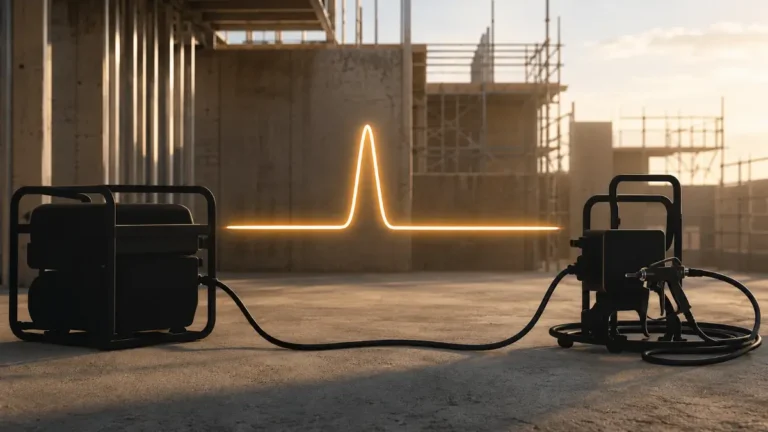
Choosing between a hydraulic vs electric airless sprayer comes down to two variables: pressure ceiling and power access. Electric airless units cap at 3000 PSI (20 MPa) and need mains power, which suits interior, residential, and standard architectural coatings. Hydraulic plunger units push 6000 to 9000 PSI and can run on a petrol engine where no mains exist, built for heavy anti-corrosion epoxy, fireproofing, and bridge or steel-structure work. Match the line to the coating and the site.
Hydraulic vs Electric Airless Sprayer: How the Drive Architecture Differs
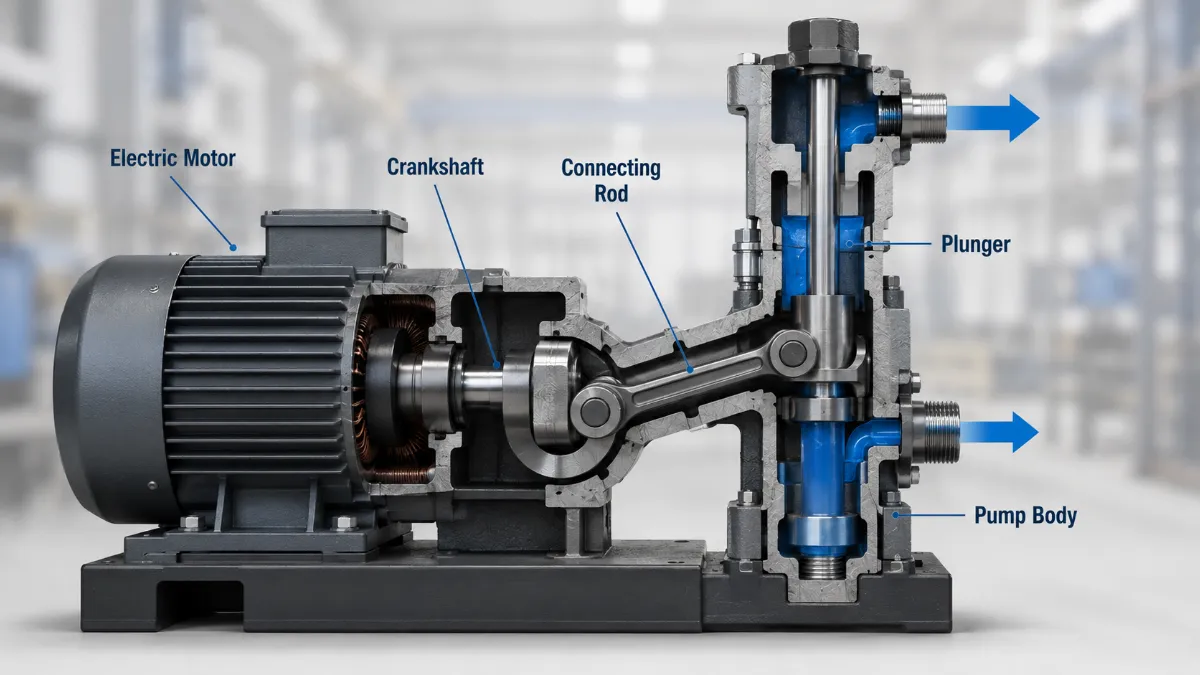
Electric sprayer pumps convert motor torque straight into piston stroke: motor, crankshaft, connecting rod, plunger. Fewer links, lower weight, quiet running. The ceiling is fixed by the motor and drivetrain, and across the GTB-9 series that ceiling sits at 3000 PSI (20 MPa).
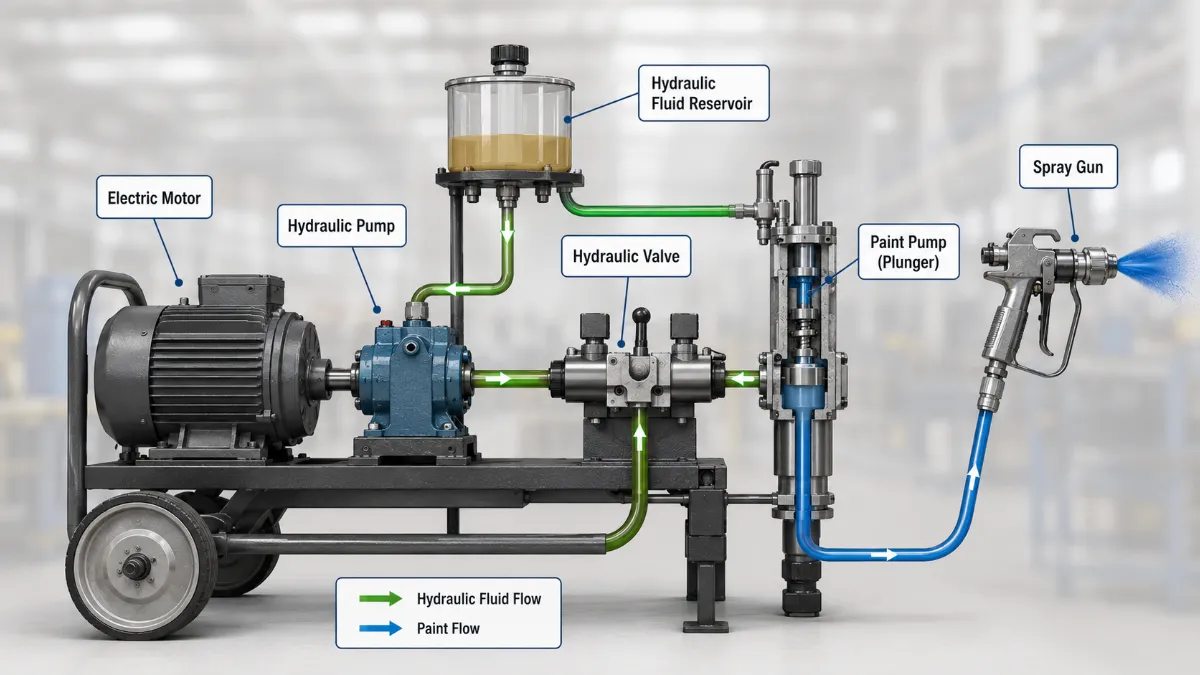
A hydraulic line adds an intermediary. An engine or electric motor spins a hydraulic pump, that pump pressurizes hydraulic oil, and the oil drives the spray plunger. That oil cushion smooths pump-changeover pulsation and lets the system hold much higher pressure without hammering the packings — the reason hydraulic rigs reach into the 6000–9000 PSI band.
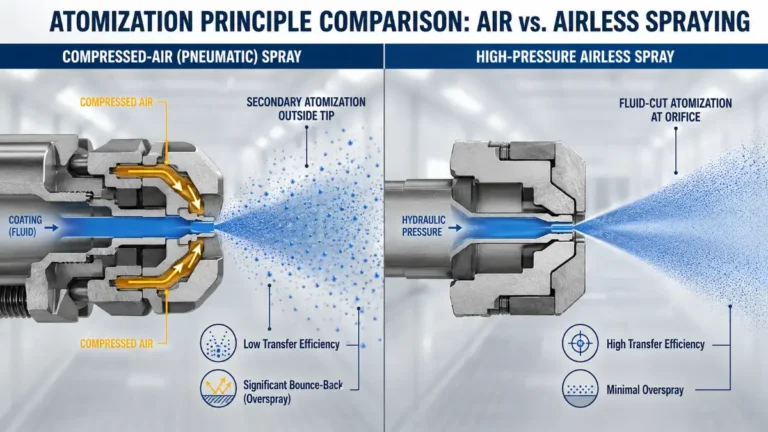
Both designs trace back to the wider pump-architecture split covered in piston pump vs diaphragm pump, and to the atomization fundamentals behind air vs airless paint sprayer. Same physics, different drivetrain.
Hydraulic vs Electric Airless Sprayer: Pressure, Flow, and Coating Limits
Pressure sets the ceiling. Viscosity decides whether you hit it. A high-solids anti-corrosion epoxy needs far more pressure to atomize than interior latex, and that single fact separates the two power lines more than any spec sheet line item.
| Dimension | Electric Airless Line (GTB-9 Series) | Hydraulic Plunger Line (GTB-970 / 833) |
|---|---|---|
| Max working pressure | 3000 PSI / 20 MPa (whole series) | 970 high-pressure 6000 PSI; 833 high-pressure 9000 PSI |
| Max flow | ~8.0 L/min (980, top of range) | 833 standard 20 L/min |
| Max tip | 0.041″ (980 / 541) | 833 standard 0.065″ |
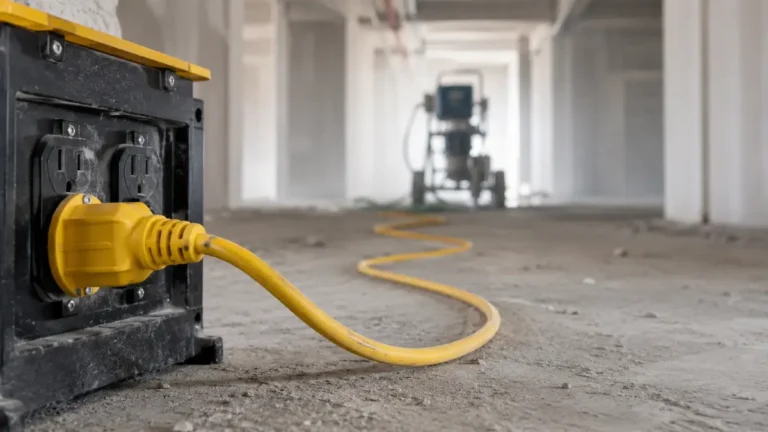
| Power source | Mains 220V required | Electric 380V, or petrol 9HP/13HP — no mains needed |
| Machine weight | 15–53 kg | 93–185 kg |
| Typical coatings | Latex, acrylic, primers, enamels, thinned epoxy | High-build epoxy, coal-tar epoxy, fireproofing, polyurethane waterproofing, bitumen |
Where mains power is missing, a gas powered airless paint sprayer settles the question on its own — the petrol engine carries a 970 line through a full shift on an open site with no generator. Brushless electric drive earns its keep on the other end: steady torque and no brush wear on long interior runs, the efficiency angle detailed in brushless and brushed airless sprayers.
One number cuts through the rest. An electric line will not exceed 3000 PSI, so any coating that demands more atomizing pressure is a hydraulic job by definition.
Which Power Line for Which Job: A Scenario Decision Matrix
Match the line to the job. The matrix below maps common contractor scenarios to the architecture that clears them without strain.
| Jobsite scenario | Recommended | Engineering reason |
|---|---|---|
| Interior residential / commercial standard paint | Electric | 3000 PSI is enough; low noise, portable, mains on hand |
| Large exterior / no mains power | Hydraulic (petrol 970) | Runs without mains; sustained high output |
| Heavy-build epoxy / fireproofing | Hydraulic high-pressure (970, 6000 PSI) | High viscosity needs high atomizing pressure |
| Bridge, steel structure, pipeline corrosion | Hydraulic (833 standard, 20 L/min) | High flow plus pressure feeds multiple guns |
| 100%-solids extreme corrosion protection | Hydraulic high-pressure (833, 9000 PSI) | Top-tier working pressure |
The 833 figures above mark the upper edge of our hydraulic capability rather than an off-the-shelf pick — that model family is in capability validation, not open ordering. A hydraulic architecture can also drive plaster and texture machines, but that sits outside a sprayer-to-sprayer comparison and is left aside here.
Multi-gun work skews hydraulic for a reason rooted in flow math. A pump should run at 30–60% of its rated capacity, and the combined orifice area of all guns must stay under the pump’s maximum flow. Hang two or three guns off one rig and only the high-flow hydraulic line keeps every tip fed.
Avoiding Mismatches: Pressure, Solvent Safety, and Worn Tips
Most field failures are matching errors, not machine faults. A few recur often enough to call out.
- Don’t push electric past its band. A 3000 PSI unit cannot atomize a high-solids coating that needs more. Thinning to force it ruins film build — verify the thinning limit against your coating manufacturer’s data sheet on-site.
- Don’t crank the pressure to fix a worn tip. A worn orifice widens and the fan narrows; raising pressure only accelerates pump wear. Replace the tip.
- Read the tip code before you load. First digit × 2 is the fan width in inches at 12″; the last two digits are the orifice in thousandths of an inch. A 517 throws a 10″ fan through a 0.017″ orifice. Wrong code, wrong atomization.
Solvent-based heavy coatings add a safety layer that no machine spec covers. CE compliance certifies machinery safety — it is not an explosion-proof (ATEX) rating, and it does not make a sprayer safe around flammable solvents. Follow the manual’s grounding procedure and keep the power unit back from the spray zone, at least 6 m (20 ft), so vapor never reaches an ignition source.
High-pressure fluid carries its own hazard. A stream from an airless tip can inject paint under the skin and cause afluid injection injury that looks minor and turns serious within hours. Trigger lock on, tip guard on, hands clear.
The Verdict and Sourcing: Matching the Power Line to Your Pipeline
One supplier, both power lines. For most interior and standard architectural work, an electric unit is the right call — lighter, quieter, mains-ready, and capped where those coatings live. For heavy anti-corrosion, fireproofing, no-mains exteriors, or high-flow multi-gun runs, the hydraulic plunger line is the only architecture that clears the spec.
Contractors and distributors who run both kinds of work usually want both lines from one source — fewer vendors, one parts channel, one quality standard. Our professional electric airless sprayer line covers the GTB-9 series up to 3000 PSI, and our heavy-duty hydraulic airless sprayer line covers the 970 family from 3000 PSI standard to 6000 PSI high-pressure.
One Source for Both Power Lines: Inside the GUTUBAO Line
Core parts are made in-house. Pump bodies, motors, and the smart control PCB are produced on our own floor — core parts made in-house. Total investment runs over $10 million USD across a line set up in 2010, with 200+ CNC machines and an annual capacity of 100,000 units.
In our CNC shop, critical machined metal mating surfaces — cylinder bores, valve seats — hold ±0.01 mm geometric tolerance, verified on a German Carl Zeiss coordinate measuring machine. Quality control is full inspection, not sampling: every PCB runs a 4-hour powered burn-in, every finished machine runs a 30-minute high-pressure load test, and three process checkpoints sit between them. The 970 hydraulic line is CE certified under the Machinery Directive 2006/42/EC (EN ISO 12100:2010, EN 60204-1:2018).
NDA-backed OEM and ODM are open on both power lines. Send the coating spec, the site power profile, and the duty cycle, and we match the architecture before tooling — request a quote with those three inputs.
FAQ
What’s the difference between hydraulic and electric airless sprayers? Electric units drive the plunger directly from a motor and cap at 3000 PSI (20 MPa). Hydraulic units use pressurized oil as an intermediary and reach 6000–9000 PSI, with higher flow and weight to match.
Can an electric airless sprayer handle heavy coatings? Up to a point. Standard electric lines top out at 3000 PSI, which covers latex, primers, enamels, and thinned epoxy. High-build anti-corrosion epoxy and fireproofing need the hydraulic high-pressure line.
When should a contractor choose hydraulic over electric? When the coating needs more than 3000 PSI to atomize, when the site has no mains power, or when multiple guns must run off one pump. Bridges, steel structures, and heavy industrial corrosion work fall here.
Are hydraulic sprayers more expensive to run? They carry heavier maintenance and fuel or power demands than a compact electric unit, and they cost more up front. On the heavy specs they’re built for, the throughput and pressure justify the difference; on standard paint, an electric unit is the lower-cost path.