Piston Pump vs Diaphragm Pump [2026 Updated]: How They Wear
The main difference in a piston pump vs diaphragm pump comparison is how each pump moves paint and which components wear down over time. A piston pump moves a piston rod through a V-packing set inside a cylinder sleeve. The packings, piston rod, cylinder sleeve, and check valves will experience wear. A diaphragm pump uses a flexible diaphragm to move paint through a fluid chamber. Since no seal slides through the paint, the deterioration is concentrated on the diaphragm and check valves. Abrasive, particle-laden coatings are easier on the diaphragm layout; clean, low-abrasion coatings are easy on either. Maximum operating pressure depends on the specific machine rather than the pump type.
Piston Pump vs Diaphragm Pump: Defining the Core Mechanics
Both piston and diaphragm pumps draw paint from the suction side and deliver it to the hose under pressure. Both use check valves to maintain one-way flow, but the way they move paint differs.
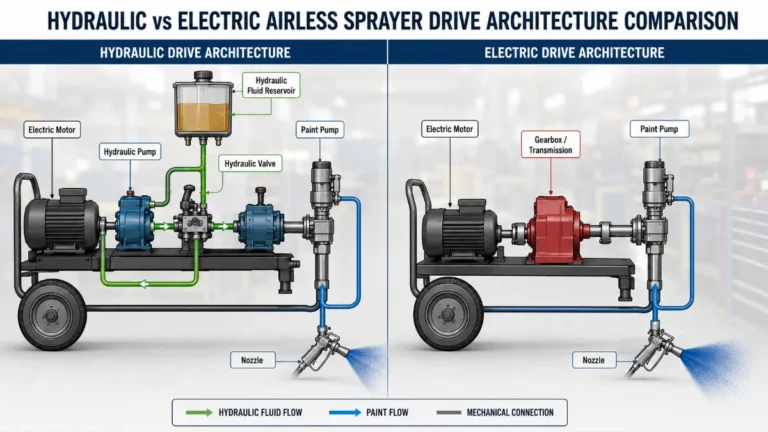
In a piston pump, a piston rod moves back and forth inside a cylinder sleeve. As the rod moves, the inlet check valve opens to draw paint in, while the outlet valve allows paint to flow toward the hose. A set of V-packings seals around the rod, which slides through the packings with each stroke.
A diaphragm pump uses a flexible diaphragm to expand and contract the fluid chamber, drawing paint in and pushing it out through the check valves. Unlike a piston pump, it has no rod sliding through the paint. Instead, the diaphragm separates the paint from the drive side.
These differences affect how each pump wears.
Before opening either pump type, turn off the sprayer and follow the pressure release procedure outlined in the manufacturer’s manual. On the job site, follow the OSHA guidelines on spray operations.
Anatomy of the sprayer piston pump: The high-durability ceramic-coated rod
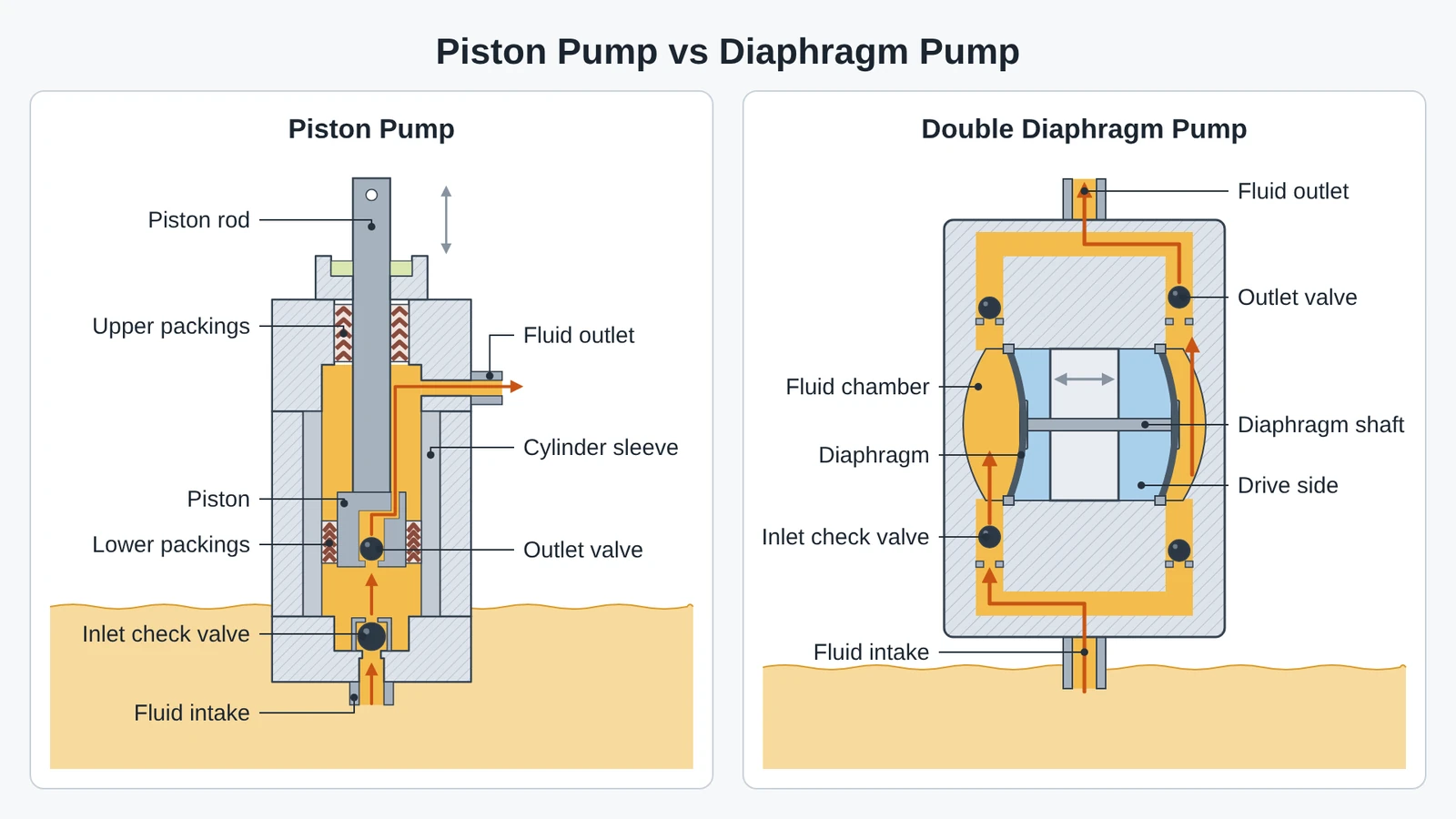
Both halves of the cutaway are generic diagrams of the pump types, not drawings of any GUTUBAO model.
Four main components are responsible for a piston pump’s operation, each with its own wear points:
- Piston rod: Moves back and forth through the packings with each stroke. Scratches on the rod’s surface can gradually damage the packings as it slides through them.
- Cylinder sleeve: Houses the piston rod as it moves. Abrasive particles trapped between the rod and sleeve can scratch and wear down both surfaces.
- V-packing set: Seals around the piston rod to maintain pump pressure. Because the packings are made of softer material than the rod, they typically wear out first.
- Check valves: The inlet and outlet valves use a ball and seat to control paint flow. Grit can damage these surfaces, preventing a proper seal and allowing paint to flow backward.
Our example of a piston-pump machine here is the GTB-495. It is driven by a 1500W brushless DC motor. The GTB-495 has a Max. Working Pressure of 3,300 PSI (227 bar / 22.7 MPa). Its maximum spray tip size is 0.021″. Its flow rate is 2.2 L/min.
Two versions of the GTB-495 are sold. The Dual-Ceramic Version: ceramic-coated rod, ceramic-lined cylinder sleeve (stainless shell + ceramic bore). The Stainless Steel Version: stainless steel rod, stainless steel cylinder liner.
Diaphragm Pump Mechanics: Flexibility in High-Shear Coatings
In a diaphragm pump, nothing slides through paint. Instead, it uses a flexible diaphragm secured around its edges that bends back and forth to move paint. Apart from the check valves, the diaphragm is the only moving component in contact with the paint.
Diaphragm pumps can therefore handle coatings containing fillers, grit, or fibers without abrasive particles becoming trapped between a piston rod and its packings. With no sliding seal exposed to the paint, there is less opportunity for abrasive wear in that area.
In airless spraying, the coating experiences shear as it passes through the spray tip, where high pressure forces it through a small opening. Both pump designs supply the pressure needed to deliver paint to the tip.
Repeated flexing wears the diaphragm itself and can eventually cause material fatigue. Particles in the coating can also wear down the check valves. If the diaphragm ruptures, paint can pass through it and enter the drive side.
Performance Showdown: Piston vs. Diaphragm in Extreme Conditions
Abrasive particles affect different components in piston and diaphragm pumps. The table below compares how each pump handles abrasive and thick coatings, along with the wear patterns associated with each design.
| Feature | Piston Pump | Diaphragm Pump |
|---|---|---|
| How paint is moved | Piston rod strokes inside a cylinder sleeve; check valves direct the flow | Diaphragm flexes against a fluid chamber; check valves direct the flow |
| Seal against the moving part | V-packing set slides along the rod | No sliding seal in the paint; the diaphragm separates paint from the drive side |
| Main wear parts | V-packing set, piston rod, cylinder sleeve, check valves | Diaphragm, check valves |
| Abrasive or filled coatings | Particles reach the rod, the sleeve, and the packings | Particles reach the check valves; no rod or packings in the paint |
| Thick coatings | Must refill through the inlet check valve between strokes | Must refill the fluid chamber between strokes |
| Typical sign of wear | Paint at the packing nut; pump keeps stroking with the gun closed | Output drops as the valves wear; a split diaphragm lets paint reach the drive side |
The table highlights a key difference in how each pump wears. In piston pumps, wear primarily affects sliding components, while diaphragm pumps experience wear in components that flex or seal against a seat. Maintenance cost depends on the coatings used.
With clean, low-abrasion architectural coatings, piston rods and packings experience less wear. For coatings containing fillers or grit, diaphragm pumps keep abrasive particles away from sliding seals, reducing wear in those areas.
However, if a coating is too thick for either pump to draw in properly, the issue comes down to selecting a machine with the appropriate capacity rather than choosing between pump designs.
Pressure ratings are excluded from the table because they depend on the specific machine, not the pump type alone. If your main concern is achieving a fine finish at lower pressure, our airless paint sprayer vs HVLP comparison provides a closer look at those differences.
V-Packings (UPE & cowhide): Why Throat Packings Wear and When to Replace Them
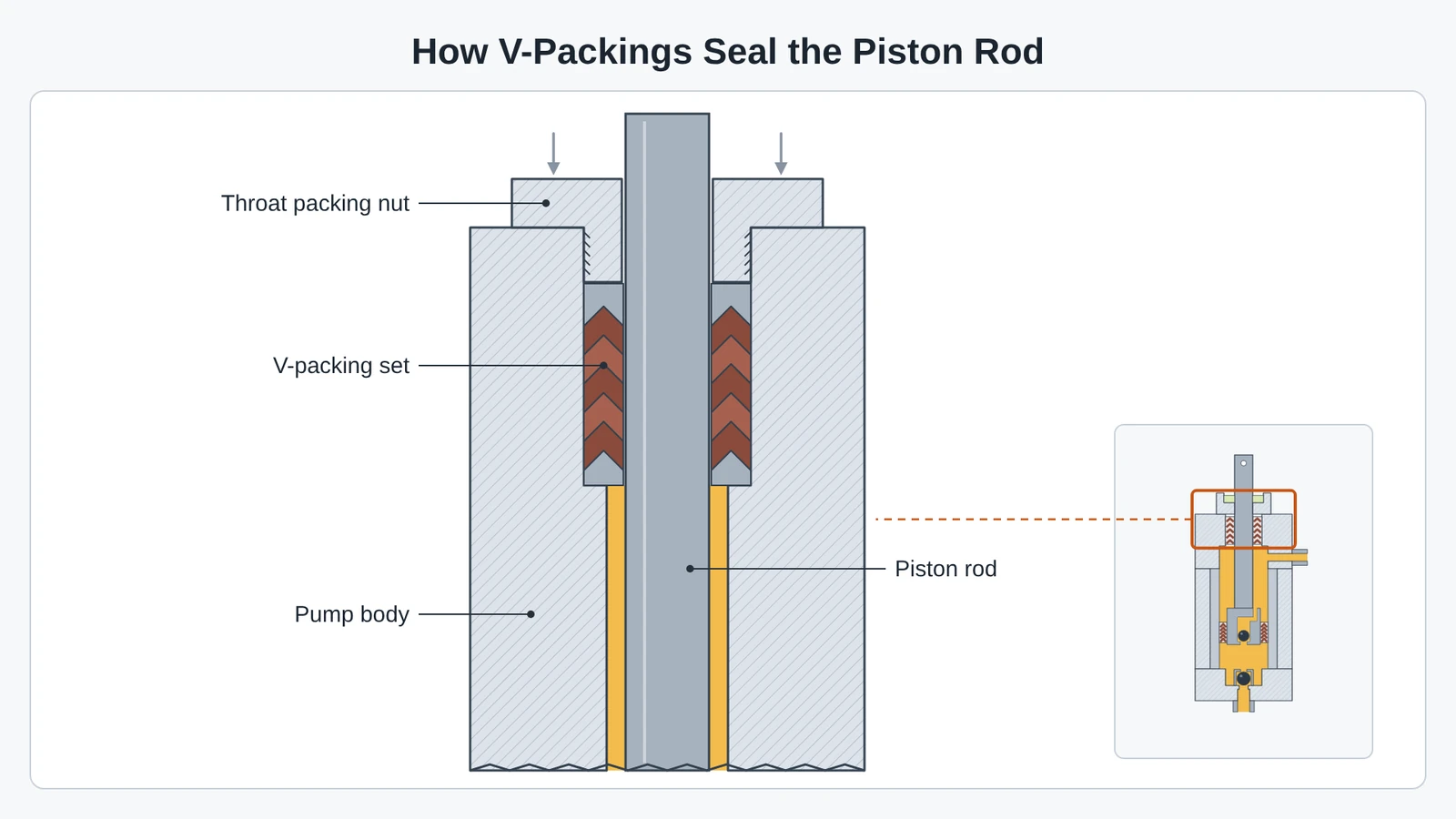
As shown in the close-up, the packing nut compresses the V-packing set around the piston rod. The packings maintain a seal under full pump pressure while allowing the rod to move through them with each stroke. The packings in the GTB-495 pump are V-Packings (UPE & cowhide).
Abrasive particles in the coating can collect on the piston rod and enter the seal as it moves. Dried paint on the exposed rod can also be pulled into the packings during the next stroke.
To reduce wear, keep the exposed rod clean and apply piston rod lubricant as recommended by the manufacturer. The GTB-495 ships with piston rod lubricant in the box.
Running more pressure than the coating needs wears the packings faster, along with the tip. As an industry rule, do not raise pressure to compensate for a worn tip; it fixes nothing and speeds up wear on the tip, the pump, and the packings. Replace the tip instead.
Three signs may indicate worn packings:
- Fluid leakage: Paint or fluid leaks around the packing nut.
- Continuous cycling: The pump continues stroking after the trigger is released, which may indicate fluid leaking past the packings or one of the check valves.
- Pressure loss: Pump pressure drops and the spray fan narrows, even when the spray tip is in good condition.
If worn packings are the cause, replace the V-packing set and inspect the piston rod and cylinder sleeve while the pump is disassembled. Installing new packings on a scratched or scored rod can cause premature wear, as the damaged surface continues to scrape against the packings with each stroke.
Upgrading Your Arsenal: Selecting sprayer pump parts for Longevity
Wear components in a piston pump fall into two main groups. The V-packing set and check valves provide the seals and are typically the first to wear. The piston rod and cylinder sleeve provide the surfaces the packings run against, and their condition directly affects how long replacement packings last.

For a detailed breakdown of each component, refer to our sprayer pump parts guide. Replace components based on their condition and signs of wear:
- V-packing set: Replace when the signs of wear described in the previous section appear.
- Check valves: Inspect for pitting or chipping on the ball or seat, particularly if the pump is slow to prime or cannot maintain pressure.
- Piston rod: Replace if the surface is scored or no longer smooth where it passes through the packings.
- Cylinder sleeve: Replace if the bore is scored.
When ordering replacement rods or sleeves for a GTB-495, specify both the model and version, as the two versions use different rods and sleeves. How the pump body and its bores are made is covered in CNC Machining of GUTUBAO Fluid Pumps.

Lower Your TCO: Source Your complete sprayer pump from GUTUBAO
A sprayer pump’s total cost of ownership comes down to three factors: replacement parts, downtime while waiting for those parts, and the cost of keeping spare components on hand. Choosing a pump that suits your coatings shifts these expenses; it does not remove them.
When purchasing a sprayer, request pricing for replacement parts alongside the machine itself.
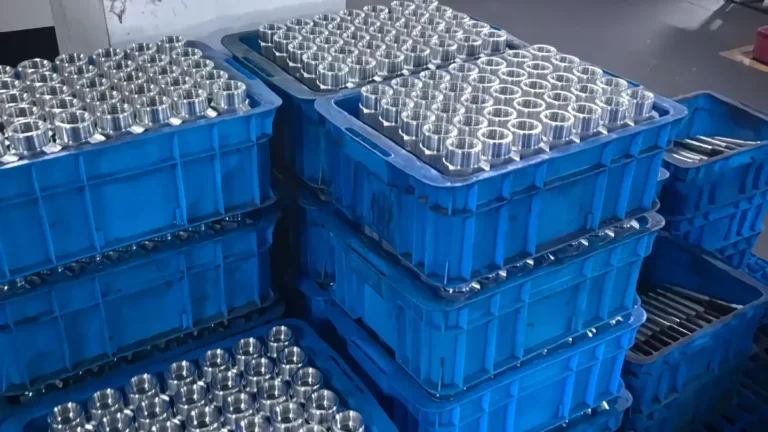
GUTUBAO was established in 2010. More than 200 CNC machines run in our machining shop. Our pump bodies are machined on Brother SPEEDIO centers from Japan. Our connecting rods are machined on Haas CNC machines from the USA.
Concentricity is checked on a Carl Zeiss coordinate measuring machine. Our ±0.01mm tolerance applies to critical machined metal mating surfaces, not to every part. Our 100% in-house production of core components covers pump bodies, motors, and control PCBs.
We conduct first-piece, in-process, and final inspections, with every machine undergoing a full inspection rather than sampling. Finished machines then pass two-stage testing. The control PCB is burned in under power for 4 hours. Then the assembled machine spends 30 minutes at continuous high-pressure load.
Annual capacity is 100,000 units. Our share of the domestic market is about 70%, and we export to dozens of countries. Distributors who sell under their own brand can work with us through OEM/ODM customization (NDA-backed).
FAQ
Is a diaphragm pump better than a piston pump for abrasive coatings?
Often, because the abrasive material never reaches a sliding seal. In a piston pump, grit wears down the rod, sleeve, and packings simultaneously. A diaphragm pump keeps abrasive particles away from these components, although its check valves are still subject to wear. With clean, low-abrasion coatings, the difference in wear is less significant.
Why does a piston pump keep stroking when the gun is closed?
Fluid is leaking internally past the packings or one of the check valves that no longer seals properly. The pump should stop stroking once the trigger is released. If it continues cycling, inspect these components for leaks. Replacing the spray tip or increasing pressure will not resolve the issue.
Does the pump type set an airless sprayer’s maximum pressure?
No. An airless sprayer’s maximum pressure is determined by the machine as a whole, not just the pump type. Check the machine’s specification sheet for its maximum pressure rating. The appropriate spraying pressure depends on the coating being used and should be verified against the coating manufacturer’s technical data sheet.
As a rule of thumb, use the lowest pressure that still produces a full, clean fan.