Airless Sprayer vs Roller: Which is Better? 2026 Updated
An airless sprayer vs roller decision depends on three factors: project size, paint efficiency, and the desired finish. An airless sprayer pumps paint directly from the pail and applies it through a spray tip which provides fast coverage across large surfaces. The downside is that overspray increases paint waste and requires additional masking. Rollers waste less paint, but application takes longer and leaves a slightly textured finish. Airless sprayers are suited for large walls, ceilings, and exterior projects, while rollers are more practical for smaller spaces, occupied areas, and touch-ups.
How Much Faster is a Paint Sprayer Than a Roller? (Efficiency Showdown)
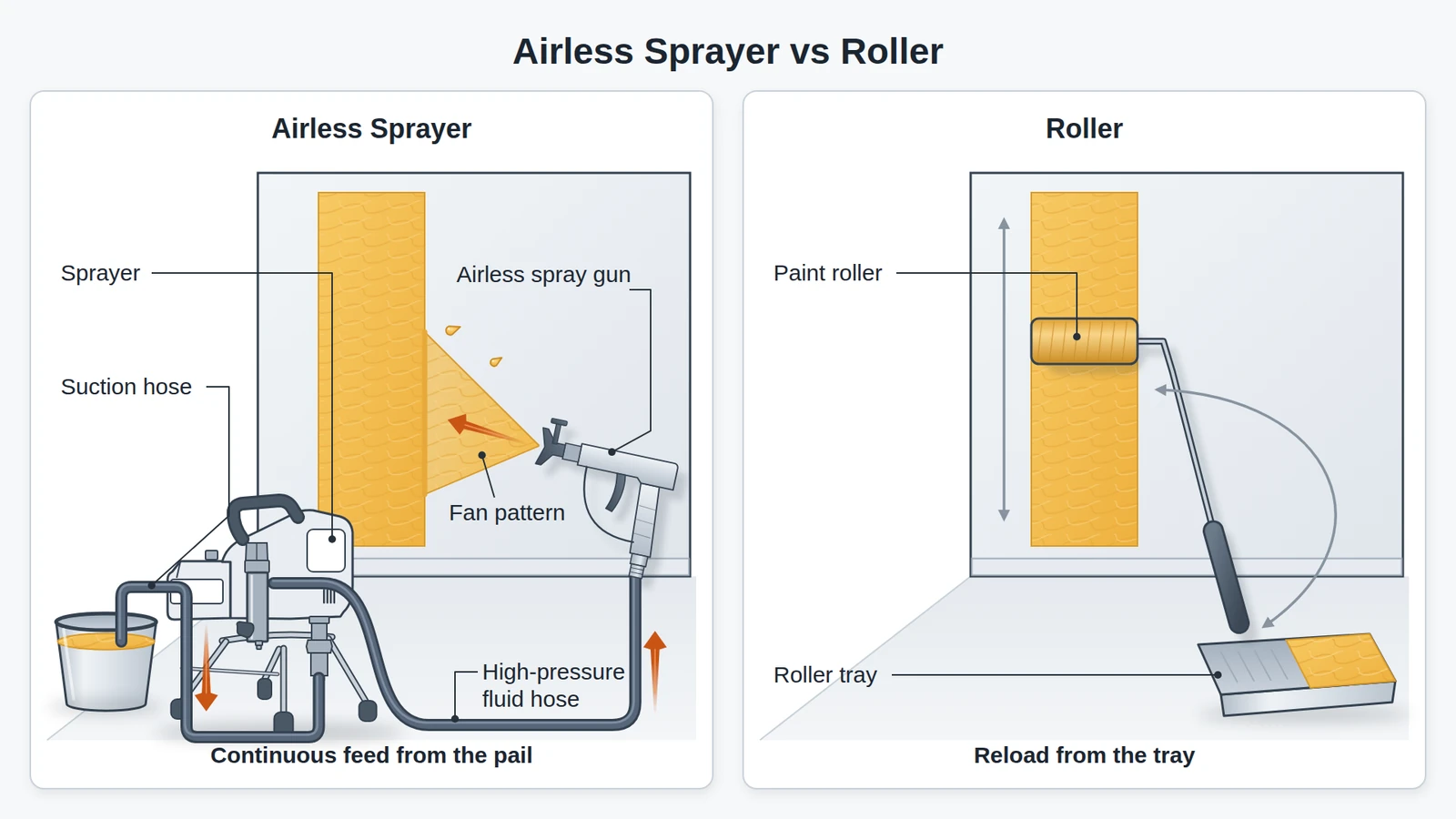
Airless sprayers cover large surfaces faster than rollers, with the time saved depending on the project. An airless pump draws paint directly from the pail and delivers it through a hose and spray tip, allowing continuous application while the trigger is held. Rollers require reloading every few strokes, adding interruptions that become more noticeable on larger surfaces.
We don’t give a fixed speed multiplier because the actual difference varies by project. Three factors help explain how much time spraying can save:
- Surface area per setup: Masking, hose setup, and cleanup add to the overall cost of the job. On a large ceiling, these costs are spread across a greater area, making them less significant relative to the work completed. On a single accent wall, the same costs account for a much larger share of the job.
- Coating changes: Switching colors or coatings requires flushing the sprayer’s pump, hose, and gun. With a roller, only the cover needs replacing.
- Obstructions: Open walls are faster to spray. Windows, cabinets, and fixtures require additional masking, which can take longer than the painting itself.
On large, open surfaces, continuous spraying allows more time to be spent applying paint rather than reloading a roller. As the area increases, the time saved during application can outweigh the additional setup and cleanup required. On small or broken-up walls, the roller still comes out ahead.
Does an Airless Sprayer Use More Paint Than a Roller? (Overspray Explained)
In most cases, an airless sprayer uses more paint than a roller because not all of the sprayed paint reaches the intended surface. The difference between the two comes down to transfer efficiency, which measures how much of the sprayed coating actually lands on the target.
Paint that misses the surface is known as overspray. It occurs when airborne droplets drift beyond the target, bounce off the surface, or dry before reaching it.
Rollers generally waste less paint because they apply the coating directly without atomization. Most paint loss comes from material left in the roller cover or tray.
There is no universal transfer-efficiency percentage for airless sprayers. Paint consumption varies depending on the coating, spray tip, pressure settings, and operator technique. For accurate material estimates, contractors should refer to the coating manufacturer’s technical data sheet and account for potential overspray when preparing a bid.
Excessive spray pressure, an incorrect fan size, and improper gun distance can all increase paint waste. When pressure is set too high, the paint breaks into finer droplets that are more likely to drift or bounce off the surface.
A spray fan that is too wide for the target sends paint past the intended surface, whereas holding the gun too far away causes the droplets to dry before reaching the surface.
Four adjustments can help reduce overspray:
- Use the lowest effective pressure. Start with a low setting and test the spray pattern on cardboard. Gradually increase the pressure until the fan is even and the streaks at its edges disappear. Avoid increasing pressure beyond what is necessary.
- Choose the right spray tip. Match the fan width to the surface being painted. Narrow fans are better suited for trim and smaller surfaces, while wider fans suit open walls. In the industry-standard three-digit tip code, the first digit multiplied by two indicates the approximate fan width in inches at a 12-inch spraying distance. The last two digits indicate the orifice size in thousandths of an inch. Refer to our airless spray tip size chart for recommended tip sizes by coating type.
- The industry benchmark is to hold the gun approximately 12 inches (30 cm) from the surface and perpendicular to it.
- As a rule of thumb, overlap each pass by approximately 50%; consistent overlap reduces visible stripes and the need for additional passes.
These adjustments can improve paint utilization, but they do not eliminate overspray entirely.
For projects involving furnished rooms, fixtures, or limited working space, rollers offer a practical advantage. Because they apply paint directly to the surface, nothing is atomized and nothing drifts, reducing the need for extensive masking and protecting surrounding areas from unwanted paint.
Airless Paint Sprayer vs Roller: Finish Quality by Surface Type
Rollers and airless paint sprayers produce different finishes. Rollers leave a subtle texture from the roller cover, while sprayers atomize paint into fine droplets that merge to form a coating. When applied correctly to a properly prepared surface, spraying can produce a uniform finish with minimal visible texture.
However, the best application method depends on the surface material and the desired result.
Smooth, non-porous surfaces, such as metal doors, cabinet fronts, and previously painted smooth walls, are better suited to sprayer application. Roller marks and stippling are more noticeable on these surfaces, so spraying is often the better choice for achieving a smooth finish.
To preserve an even film, avoid back-rolling after spraying, as doing so can leave visible texture in the wet paint.
Porous or textured surfaces, such as new drywall, concrete block, stucco, and rough-sawn wood, require thorough paint coverage across pores and uneven areas. While spraying provides efficient application, back-rolling while the paint is still wet helps work the coating into surface irregularities for a more consistent finish.
For repainting projects, matching the existing surface texture is also important. If a wall was previously painted with a roller, using the same application method can help maintain a consistent appearance.
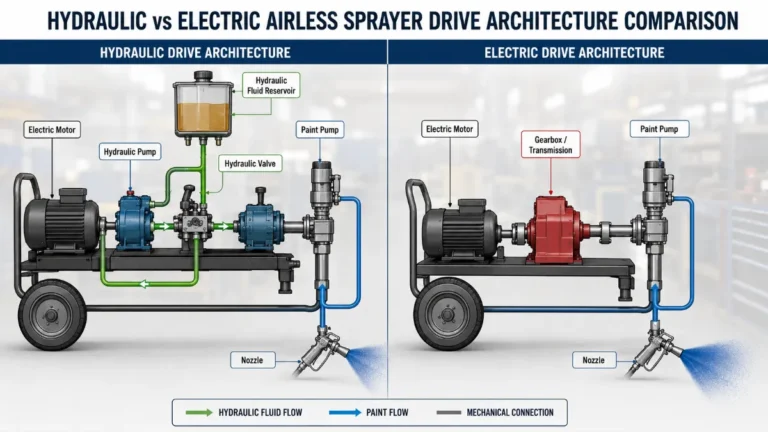
Beyond application technique, the type of airless sprayer used can also influence the quality and consistency of the final finish. For reference, the model we put against a roller here is the GTB-495. The GTB-495 runs a 1500W brushless DC motor.
A brushless DC motor gives consistent torque, higher efficiency, and no carbon-brush wear. Its Max. Working Pressure is 3,300 PSI (227 bar / 22.7 MPa). It accepts spray tips up to 0.021″ and delivers 2.2 L/min. Its pump seals are V-Packings (UPE & cowhide).
The GTB-495 is sold in two versions: a Dual-Ceramic Version with a ceramic-coated rod and a ceramic-lined cylinder sleeve (stainless shell + ceramic bore), and a Stainless Steel Version with a stainless steel rod and a stainless steel cylinder liner.
Spray vs Roll Interior Walls: The Prep Time Equation
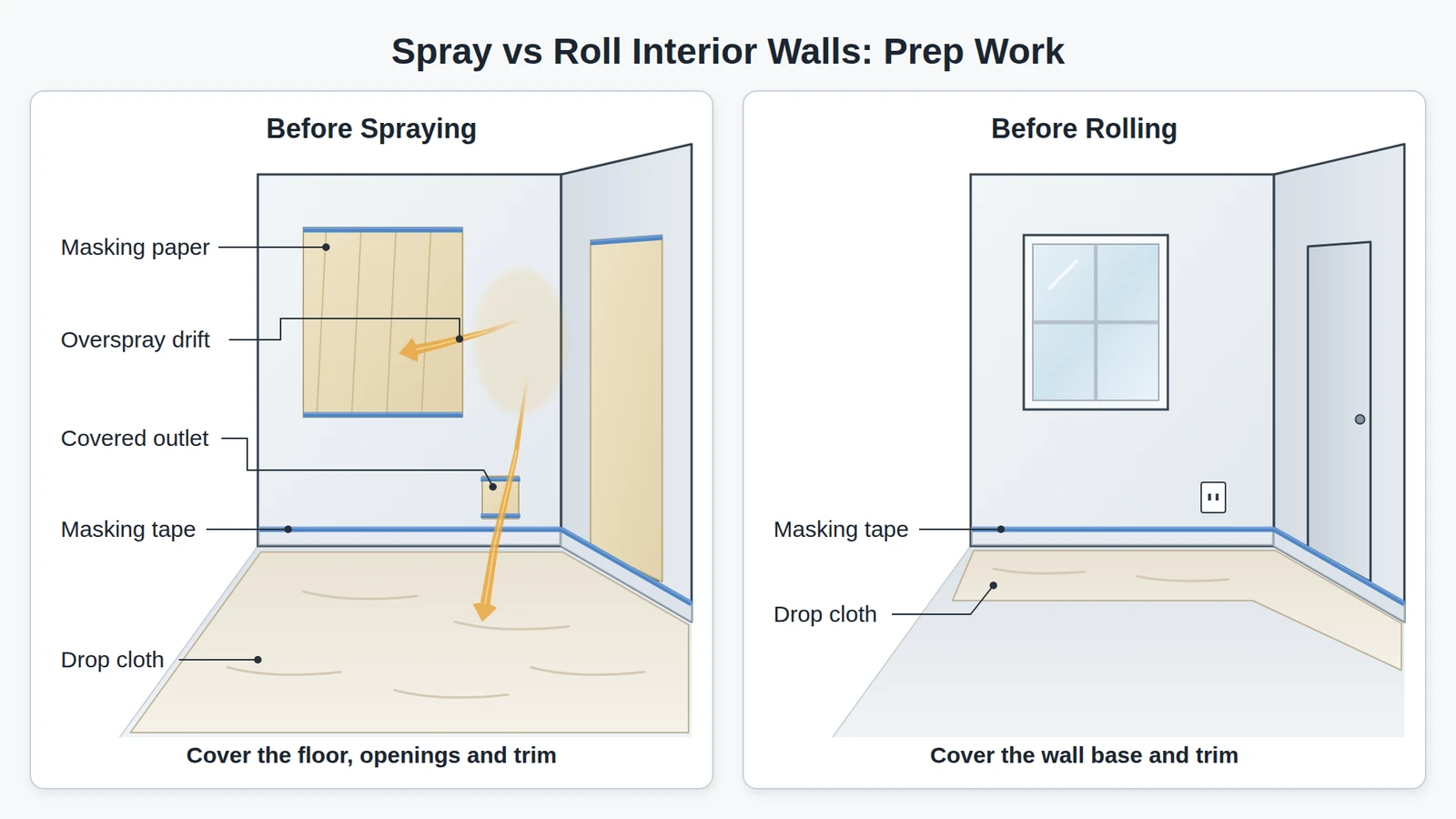
Preparation is quicker when using a roller. Spray painting requires more extensive masking because overspray can spread to furniture, windows, and other surfaces, often requiring the room to be emptied or sealed off. In contrast, roller painting requires less protective covering around the floor, trim, and nearby surfaces.
Before spraying an interior room:
- Clear the room, or move the contents to the center and cover them.
- Cover the floor edge to edge with drop cloths or masking paper, taped at the base of the wall.
- Mask windows, doors, trim, and every surface that is not being sprayed, with masking tape and masking paper.
- Switch off power to the room, remove the cover plates from outlets and switches, and tape over the openings.
- Seal the doorway to the rest of the building.
- After the last coat, flush the pump, hose, and gun, then strip the masking.
Rolling the same room takes three steps:
- Run a drop cloth along the base of the wall.
- Tape the trim line and remove the cover plates.
- Cut in the edges and corners with a brush.
Surface preparation is the same for both methods, including filling holes, sanding, removing dust, and priming. The difference is in the time required for masking and paint application.
Masking involves a relatively fixed amount of work per room, while application time depends on the surface area being painted. As a result, spray painting may be more efficient in large, open rooms where preparation costs are spread across a larger area, whereas smaller or more cluttered rooms may require proportionally more preparation time.
The Contractor’s Guide: When to Choose Which Tool
Select the method based on the job requirements. Use the following five points to determine the most suitable approach.
| Feature | Airless Sprayer | Paint Roller |
|---|---|---|
| Application Speed | Continuous feed from the pail with no reload stops; pulls ahead on large, open surfaces | Stops to reload at the tray; holds its own on small or broken-up areas |
| Finish Quality | Continuous atomized film; no stipple on smooth substrates | Stipple texture from the cover; easier to match on repaints |
| Prep Time | High: full masking, room cleared, equipment flushed afterward | Low: drop cloth and taped trim |
| Paint Consumption | Higher: part of the coating is lost to overspray | Lower: losses limited to the cover and the tray |
| Ideal Project Size | Large, open, or exterior surfaces; new construction; repeated identical units | Small rooms, occupied spaces, single walls, touch-ups |
The table highlights the key trade-offs between spraying and rolling. Spraying offers faster application on large, open surfaces, but this advantage must be weighed against the additional time required for masking, setup, and equipment cleaning.
Finish requirements and the substrate are specification questions, not cost questions: a smooth-film requirement or a porous substrate decides the method before cost comes into the comparison.
Professional painting crews often use both methods within the same project rather than relying exclusively on one. They may spray large, open surfaces for faster coverage while using rollers for smaller areas, occupied rooms, and surfaces where extensive masking would outweigh the time saved.
If a fine-finish requirement is pushing you toward a low-pressure method rather than a roller, our airless paint sprayer vs HVLP comparison draws that boundary.
GUTUBAO Factory Direct Advantage: High-Duty Solutions for Pros
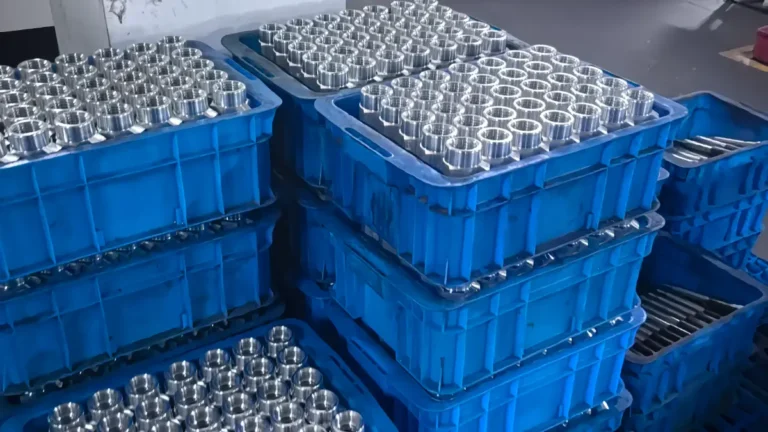
GUTUBAO was founded in 2010. Our shop runs more than 200 CNC machines, including Brother and Haas machining centers, and a Carl Zeiss coordinate measuring machine checks critical pump geometry. The ±0.01mm figure applies to the critical machined metal mating surfaces, a cylinder bore or a valve-seat bore, and we do not extend that number to the rest of the machine.
100% in-house production of core components is our standing practice: the pump body, the motor, and the control PCB come off our own lines. Each finished unit then passes a two-stage test before it leaves. First, the control PCB is powered for a 4-hour burn-in. Second, the assembled machine is run for 30 minutes under continuous high-pressure load.
Inspection runs in three stages, first-piece, in-process, and final, and every unit is inspected rather than a sample. We hold about 70% of our domestic market and export to dozens of countries. We also build under customers’ own brands through OEM/ODM customization (NDA-backed).
FAQ
How much faster is a paint sprayer than a roller on a large wall?
Time saved by using an airless sprayer instead of a roller depends on the size and complexity of the project. Sprayers allow for continuous paint application without frequent reloading, making them more effective on large, open surfaces. However, walls with multiple windows, doors, or fixtures require additional masking, which can reduce the overall time saved.
For larger projects, testing both methods in a single room can help estimate labor time more accurately before preparing a bid.
Do you have to back-roll after spraying interior walls?
Back-rolling is recommended for porous or textured surfaces that require paint to be worked into pores and uneven areas. Surfaces such as new drywall, concrete block, stucco, and rough wood can benefit from back-rolling while the sprayed coating is still wet for more even coverage.
For smooth surfaces, including previously painted walls, metal doors, and cabinet fronts, do not back-roll, as it can introduce visible roller texture into an otherwise even finish.
Which tip should you start with for latex wall paint?
A 517 is the common starting tip for latex among professionals. A 515 puts out slightly less and is easier to control, so it is often suggested to newer operators. Check that the tip’s orifice size is within the sprayer’s maximum rating, then select the appropriate size based on the coating’s viscosity and required film thickness.
Is a roller ever the better choice on a commercial job?
Yes. Roller painting is often the better choice when the time required for masking and preparation outweighs the time saved through spraying. Occupied offices, single-wall projects, areas requiring frequent color changes, and repaints that need to match an existing roller-applied texture are all situations in which a roller may be more efficient, regardless of the total surface area.